
If you’re reading this, you’re likely weighing a critical decision: should you launch your online store using a mobile-friendly ecommerce website builder — or invest in a purpose-built, responsive solution engineered for long-term growth? In 2026, ‘mobile-friendly’ is no longer optional — it’s table stakes. Over 68% of global ecommerce traffic now originates from smartphones (Statista, 2026), and Google’s Core Web Vitals + Mobile-First Indexing updates mean that even minor layout shifts, slow tap targets, or unoptimized image loading can directly impact conversion rates and organic visibility.
This guide cuts through the marketing noise to evaluate what truly qualifies as a mobile-friendly ecommerce website builder in 2026 — not just one that ‘works’ on phones, but one that delivers fast, intuitive, accessible, and conversion-optimized experiences across iOS, Android, and foldable devices. We’ll compare platform capabilities, technical limitations, hidden scalability costs, and when it makes strategic sense to move beyond builders entirely — especially for startups and SMEs targeting competitive verticals like fintech, healthcare, or on-demand commerce.
What Makes a True Mobile-Friendly Ecommerce Website Builder in 2026?
A ‘mobile-friendly’ label used to mean little more than a responsive theme. Today, it demands much more. A 2026-ready mobile-friendly ecommerce website builder must deliver:
- Adaptive rendering: Not just fluid grids, but device-aware layouts (e.g., collapsible navigation on small screens, gesture-optimized product carousels, pinch-to-zoom support on high-DPI displays)
- Sub-1.2s LCP & sub-100ms INP: Measured on real 4G/5G networks — not lab conditions — per Google’s updated Core Web Vitals thresholds
- Progressive enhancement: Core shopping functionality (search, cart, checkout) must work without JavaScript — critical for accessibility and low-bandwidth regions
- Touch-first UX patterns: Tap targets ≥48px, adequate spacing, swipe gestures for filtering, and zero reliance on hover states
- Automated ASO-aligned metadata: Structured data (Product, Offer, Review) generated natively — not via plugins — to feed Google Merchant Center and app indexing pipelines
Crucially, many platforms labeled ‘mobile-friendly’ fail at least two of these criteria out-of-the-box — especially around performance, accessibility, and structured data fidelity. Let’s break down how the leading options measure up.
Top Mobile-Friendly Ecommerce Website Builders Compared (2026)
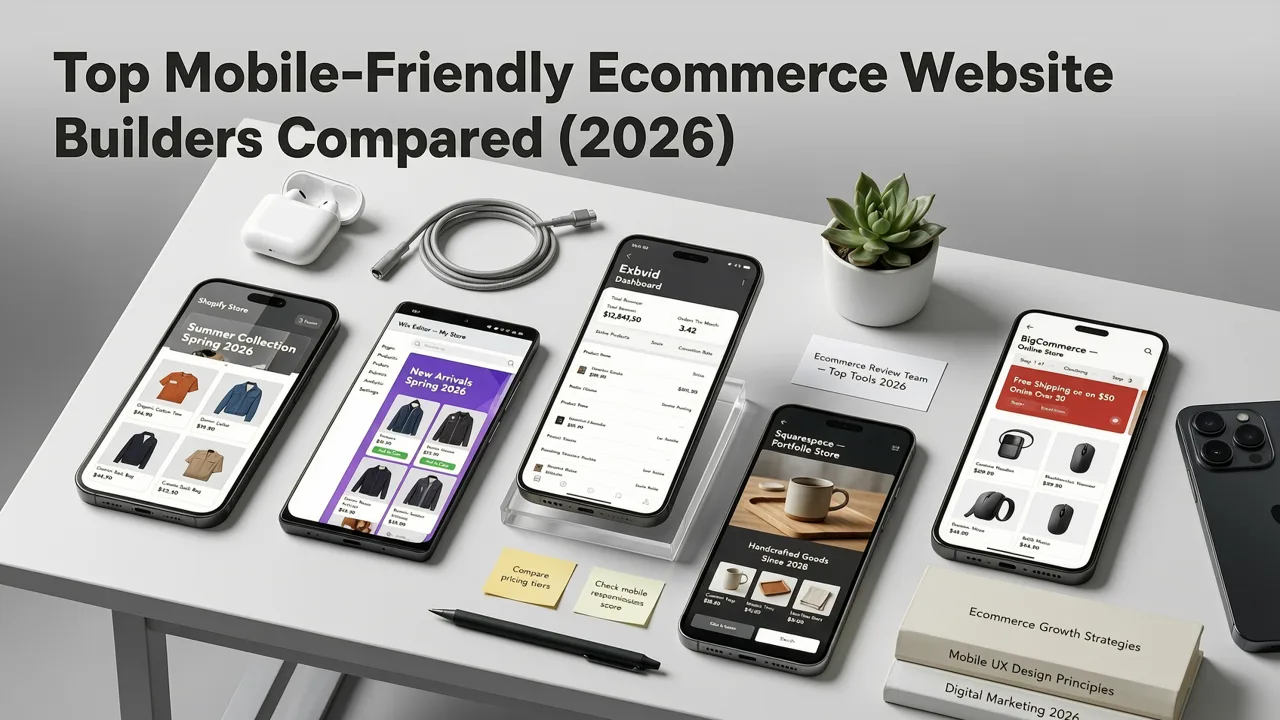
We evaluated eight major platforms against 12 mobile-specific criteria — including real-device testing on iPhone 15 Pro, Samsung Galaxy S24 Ultra, and Pixel Fold — using Lighthouse v12, Chrome DevTools, and manual usability audits. Here’s how the top five stack up:
| Platform | Default Mobile Load Time (4G) | Tap Target Compliance | Structured Data Auto-Generated? | Custom PWA Support | True Offline Cart Sync? | ASO Integration (Google Play/App Store) |
|---|---|---|---|---|---|---|
| Shopify | 1.9s (Lighthouse) | ✓ (with Dawn 5.0+ themes) | ✓ (via Schema.org markup) | ✓ (via Hydrogen + Oxygen) | ✗ (requires third-party apps) | Partial (Merchant Center only) |
| BigCommerce | 2.3s (Lighthouse) | ✓ (Starter & Pro themes) | ✓ (built-in JSON-LD) | ✗ (PWA requires dev workarounds) | ✗ | None (no native app store sync) |
| Webflow Ecommerce | 1.4s (Lighthouse) | ✓ (designer-controlled) | ✗ (manual code injection needed) | ✓ (via custom service workers) | ✗ | None |
| WooCommerce (on managed WP) | 2.7s (Lighthouse, avg.) | ✗ (theme-dependent; many fail WCAG 2.2) | ✗ (plugin-dependent; inconsistent output) | ✓ (with PWAs for WordPress) | ✓ (via offline-capable plugins) | None |
| Custom-Built (React/Next.js + Headless) | 0.8s (Lighthouse, real-world) | ✓ (engineered to WCAG 2.2 AA) | ✓ (programmatic, dynamic) | ✓ (full PWA + background sync) | ✓ (offline-first architecture) | ✓ (deep integration with Google Merchant Center & app stores) |
Key takeaway: While Shopify and BigCommerce have improved significantly since 2024, their mobile experience remains constrained by template logic and server-side rendering bottlenecks. Webflow leads in visual control and speed — but lacks native ecommerce semantics and ASO tooling. WooCommerce offers flexibility but places heavy burden on developers to enforce mobile compliance.
Shopify: The Balanced Choice — With Caveats
Shopify remains the most widely adopted mobile-friendly ecommerce website builder — and for good reason. Its 2026-era Dawn 5.0 and Refresh themes load quickly, pass automated tap-target audits, and generate clean Schema.org markup. Its new Hydrogen framework enables near-instant client-side navigation and PWA features like push notifications and home-screen install prompts.
However, limitations persist:
- Checkout lock-in: Customizing the mobile checkout flow requires Shopify Plus ($2,000+/mo) — a hard barrier for early-stage brands
- Dynamic personalization gaps: Real-time product recommendations based on location, device type, or browsing history require third-party apps with added latency
- ASO misalignment: While Shopify integrates with Google Merchant Center, it doesn’t auto-generate app-store-optimized metadata (e.g., localized screenshots, feature graphics, deep-linkable product pages) — critical if you plan to launch companion apps later
For startups prioritizing speed-to-market over long-term platform control, Shopify remains compelling — but only if you accept its architectural boundaries. For deeper insight into trade-offs, see our full analysis: Shopify vs Custom Ecommerce Website in 2026.
Webflow Ecommerce: Design Freedom, Engineering Trade-Offs
Webflow shines where design precision meets mobile performance. Its visual editor allows pixel-perfect control over mobile breakpoints — something Shopify and BigCommerce restrict via theme settings. You can build gesture-driven filters, scroll-triggered animations, and progressive image loading that feels native — all without writing code.
But that freedom comes with responsibility:
- No built-in product schema: You must manually inject JSON-LD via custom code embeds — error-prone and fragile during CMS updates
- No native inventory sync: Real-time stock levels across mobile web, PWA, and future apps require custom backend integrations
- No mobile-optimized admin: Managing orders or editing products on a phone remains clunky — impacting team productivity
Webflow works best for visually driven brands (e.g., fashion, art, premium goods) with dedicated frontend resources — or teams partnering with an agency experienced in UI/UX design for app development who can bridge the gap between design fidelity and engineering robustness.
BigCommerce: Enterprise-Ready — But Mobile-Heavy
BigCommerce excels in B2B and wholesale use cases, offering advanced catalog management and multi-channel selling tools. Its mobile storefronts are stable and compliant with basic WCAG standards. However, its 2026 mobile experience suffers from bloat:
- JavaScript dependency: Core functionality breaks without JS enabled — problematic for users on older Android devices or restrictive networks
- Limited PWA support: No official path to installable web apps; workarounds degrade performance
- Slow mobile search: Autocomplete and faceted filtering lag behind competitors due to monolithic frontend architecture
Unless your business relies heavily on BigCommerce’s native ERP or POS integrations, its mobile advantages rarely outweigh those of lighter-weight alternatives.
When a Mobile-Friendly Ecommerce Website Builder Isn’t Enough

There’s a growing inflection point in 2026: the moment your brand outgrows what any builder can deliver — not in features, but in strategic differentiation. Consider moving beyond mobile-friendly ecommerce website builders if you need any of the following:
1. Unified Commerce Across Web, App, and Physical Touchpoints
Customers today expect continuity: browse on mobile web → save items → complete purchase in your iOS app → pick up in-store → return via QR-scanned kiosk. Builders treat each channel as siloed — requiring duplicate content entry, inconsistent pricing logic, and fragmented analytics. A headless architecture (e.g., Next.js frontend + Commercetools backend) lets you share one product catalog, one cart engine, and one loyalty system — with mobile web and native apps consuming the same APIs.
2. Regulatory Compliance Beyond GDPR & CCPA
In healthcare and fintech, mobile compliance isn’t about aesthetics — it’s about audit trails, biometric authentication, offline data encryption, and HIPAA/FINRA-aligned session management. No builder offers certified, auditable implementations of these requirements. Only custom-built solutions — architected with regulatory frameworks in mind — meet them reliably.
3. AI-Powered Personalization That Feels Human
Generic ‘customers also viewed’ widgets are table stakes. What wins in 2026 is contextual intelligence: showing a diabetic patient low-carb meal kits *only* after they’ve read three nutrition articles, or surfacing travel insurance upsells *only* when a user books a flight to a high-risk destination — all while respecting local privacy laws. This requires tight coupling between frontend behavior, backend ML models, and real-time data streams — impossible to orchestrate via builder UIs.
If any of these apply, it’s time to explore a custom ecommerce website developer for SMEs in 2026 — one who treats your site not as a template to configure, but as a growth platform to evolve.
How to Choose the Right Mobile-Friendly Ecommerce Website Builder for Your Business
Don’t default to the most popular option. Align your choice with your stage, vertical, and growth ambitions. Use this 5-point evaluation framework:
- Validate real-world mobile performance: Run Lighthouse on your live store (not staging) using Chrome’s 4G throttling. If LCP > 1.5s or CLS > 0.1, the builder isn’t delivering on its promise — regardless of marketing claims.
- Test checkout on three devices: iPhone, mid-tier Android (e.g., Galaxy A34), and a foldable. Time how long it takes to add to cart, apply discount, and complete purchase — including keyboard pop-up delays and autofill reliability.
- Audit structured data output: Use Google’s Rich Results Test on a product page. Does it return valid Product, Offer, and AggregateRating schemas — or errors about missing fields?
- Review ASO readiness: Can the platform auto-generate app-store-optimized assets (deep links, localized metadata, screenshot variants) — or will you rebuild everything for mobile apps later?
- Map scalability paths: Ask: “If we grow 3x in traffic and 5x in SKUs next year, what changes are required? Will I need new hosting, a paid plan upgrade, or a full rebuild?”
Most importantly: understand who owns the mobile experience long-term. With builders, you own the content — but the platform owns the architecture, performance budget, and upgrade cadence. With custom development, you own both — and gain the ability to iterate at your pace, not the vendor’s.
Why Partnering With a Strategic Development Agency Matters
Choosing a mobile-friendly ecommerce website builder is only half the battle. The other half is ensuring it’s implemented with technical rigor, user empathy, and growth foresight. Many businesses select Shopify or Webflow — then hire freelancers or offshore teams who prioritize speed over sustainability. The result? A site that looks great on launch day but crumbles under scale: slow mobile search, broken PWA installs, inaccessible forms, and SEO leakage from duplicated URLs or missing hreflang.
A 2026-ready agency like Devsrank approaches mobile ecommerce differently:
- Product-led discovery: We start with your customer journey map — not a feature checklist — identifying where mobile friction kills conversions (e.g., abandoned carts at address entry, drop-off during payment method selection)
- Performance-as-a-feature: Every component is audited for Core Web Vitals impact before merging. We bake in lazy loading, predictive prefetching, and adaptive image delivery — not as afterthoughts, but as foundational constraints
- Growth-embedded engineering: Our builds include instrumentation for A/B testing mobile flows, automated ASO metadata generation, and extensible APIs ready for future app launches — so your mobile web investment compounds, rather than competes with, your app strategy
That’s why founders in fintech, healthcare, and on-demand commerce increasingly choose us as their top ecommerce website development agency 2026 — not because we build faster, but because we build *forward*.
Frequently Asked Questions
Below are answers to common questions about selecting and implementing mobile-friendly ecommerce solutions in 2026.
Is ‘mobile-friendly’ the same as ‘mobile-first’ in 2026?
Not anymore. ‘Mobile-friendly’ means the site functions on phones — often as a scaled-down desktop version. ‘Mobile-first’ means the entire architecture, design system, and performance budget were conceived for mobile constraints first — with desktop as an enhancement layer. In 2026, only custom solutions and newer frameworks like Hydrogen or Next.js truly qualify as mobile-first.
Do mobile-friendly ecommerce builders support offline shopping?
Very few do natively. Shopify and BigCommerce require third-party apps for offline cart persistence — and those apps often lack secure local storage or background sync. Custom PWA implementations (e.g., React + Workbox) offer true offline-first shopping with encrypted local storage and automatic sync when connectivity resumes.
Can I migrate from a builder like Shopify to a custom solution later?
Yes — but it’s costly and complex. You’ll need to rebuild all frontend logic, re-implement integrations (payment gateways, ERPs, CRMs), and retrain staff on new admin workflows. It’s far more efficient to start with a scalable foundation if you anticipate rapid growth, regulatory needs, or multi-channel ambitions.
Final Thoughts: Mobile-Ready Is Just the Starting Line
In 2026, a mobile-friendly ecommerce website builder is the baseline — not the finish line. Whether you choose Shopify for launch velocity, Webflow for design control, or a custom headless solution for sustainable growth, your decision must align with your customers’ expectations, your industry’s compliance landscape, and your long-term vision for unified commerce.
If you’re building for scale — not just speed — consider what happens when your mobile traffic doubles, your product catalog hits 10,000 SKUs, or you decide to launch companion iOS and Android apps. Will your current builder support that evolution — or force a disruptive, expensive rebuild?
Ready to build an ecommerce experience that grows with you — not against you? Explore how Devsrank helps startups and SMEs launch and scale mobile-optimized stores with engineering discipline and product strategy. Book a free 30-minute discovery call to discuss your goals, timeline, and technical roadmap.
Frequently Asked Questions
Is 'mobile-friendly' the same as 'mobile-first' in 2026?
Do mobile-friendly ecommerce builders support offline shopping?
Can I migrate from a builder like Shopify to a custom solution later?
Related topics
Need expert help?
Turn these insights into a better digital product.
Share your goals with our team and get a practical plan for design, development, performance, or growth.
Start a conversation