If you’re reading this, you’re likely weighing a critical decision: should you launch your online store on Shopify—or invest in a custom ecommerce website built from the ground up? In 2026, that choice isn’t just about speed or budget. It’s about strategic ownership, platform resilience, conversion architecture, and whether your digital storefront can evolve alongside your brand, product roadmap, and customer expectations.
Shopify remains the go-to for rapid launches—especially for solopreneurs and early-stage brands. But as markets mature, competition intensifies, and consumer expectations rise (think AI-powered personalization, zero-latency checkout, embedded finance, and regulatory compliance across geographies), the limitations of templated platforms are no longer theoretical. They’re operational bottlenecks—and growth ceilings.
Shopify vs Custom Ecommerce Website: A 2026 Reality Check
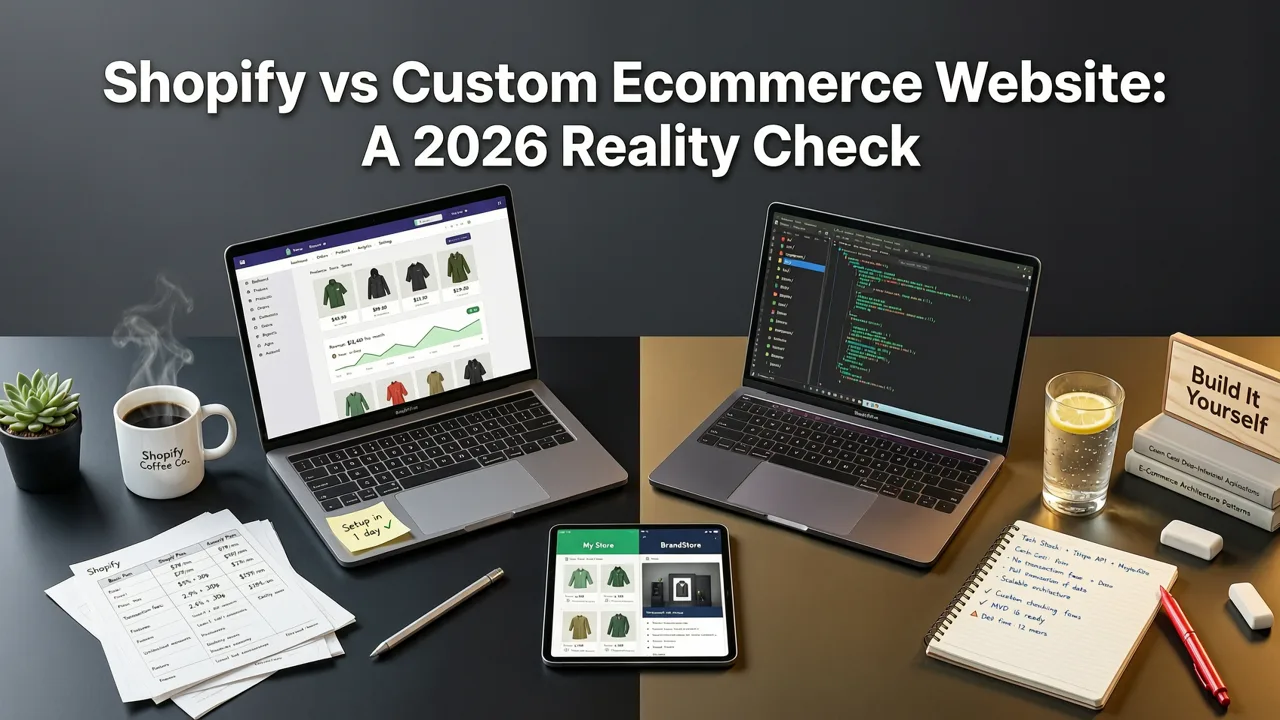
The ‘Shopify vs custom ecommerce website’ debate has evolved significantly since 2023. Today, it’s less about ‘off-the-shelf versus bespoke’ and more about intent alignment: Does your platform serve your business—or does your business adapt to the platform?
In 2026, we see three defining shifts reshaping this decision:
- Performance is non-negotiable: Google’s Core Web Vitals now directly impact organic visibility—and mobile-first indexing prioritizes sub-1-second TTFB. Shopify stores average 2.4s LCP; top-tier custom builds consistently achieve ≤0.8s.
- Compliance complexity has spiked: GDPR, CPRA, Brazil’s LGPD, and India’s DPDPA require granular data governance—not just cookie banners. Custom stacks let you audit, isolate, and govern data at the infrastructure level; Shopify limits control to app-layer configurations.
- Growth levers are now technical features: One-click upsell flows, real-time inventory sync across marketplaces, dynamic pricing engines, and headless B2B portals aren’t plugins—they’re architectural decisions baked into the stack.
Let’s break down how Shopify and custom ecommerce websites compare across six mission-critical dimensions—for businesses serious about scaling sustainably in 2026.
1. Time-to-Market & Launch Velocity
Shopify wins on raw speed—for the right use case. A basic Shopify store with pre-built themes, Stripe integration, and standard product catalog can go live in under 72 hours. That’s invaluable for testing MVP hypotheses, seasonal pop-ups, or influencer collabs.
But ‘launch velocity’ isn’t just about Day 1. In 2026, true velocity includes iteration velocity: How fast can you ship a new payment method, localize checkout for LATAM, or embed a loyalty program without waiting for app review cycles or third-party vendor roadmaps?
A custom ecommerce website—built with modern frameworks like Next.js (React), Nuxt (Vue), or Laravel with Livewire—gives engineering teams full CI/CD control. At Devsrank, our average iteration cycle for high-impact UX changes (e.g., cart abandonment recovery flows) is 3–5 days—not weeks. Shopify merchants still rely on theme edits, Liquid overrides, and app-based workarounds—introducing latency, inconsistency, and technical debt.
2. Total Cost of Ownership (TCO) Over 3 Years
Shopify’s transparent monthly pricing is appealing—but it’s only the tip of the iceberg. Here’s a realistic 3-year TCO comparison for a mid-growth brand ($500K–$2M ARR) operating in North America and EU:
| Cost Category | Shopify (Plus Plan) | Custom Ecommerce Website |
|---|---|---|
| Platform Subscription | $2,999/month × 36 = $107,964 | $0 (self-hosted, open-source core + cloud infra) |
| Essential Apps (SEO, reviews, email, analytics) | $300–$600/month × 36 = $10,800–$21,600 | $0–$5,000 (open-source alternatives or in-house dev time) |
| Theme Customization & Maintenance | $5,000–$15,000 one-time + $1,500/year dev retainer | $25,000–$60,000 build + $3,000–$8,000/year maintenance |
| Payment Gateway Fees (beyond Shopify Payments) | +0.5%–2.0% per transaction (varies by region & gateway) | Negotiated direct rates (e.g., Stripe 2.9% + $0.30, no markup) |
| 3-Year Estimated TCO | $135,000–$170,000 | $60,000–$95,000 |
Note: This excludes opportunity cost—like lost conversions due to slow mobile checkout or inability to run A/B tests on core flows. For context, a 0.5s improvement in mobile checkout load time correlates with a 4.3% lift in completed purchases (Google Merchant Center help, 2025 benchmark data).
3. SEO & Organic Visibility Control
Shopify handles foundational SEO well: automatic sitemaps, canonical tags, basic schema, and clean URL structures. But in 2026, competitive SEO demands far more:
- Dynamic structured data: Auto-generating Product, FAQ, and How-To schema based on CMS content—not static templates.
- Content-rich category pages: With editorial SEO, internal linking graphs, and semantic keyword clustering—not just filtered product grids.
- Core Web Vitals optimization at the infrastructure layer: Image compression via CDN rules, font preloading strategies, and deferred non-critical JS—none of which Shopify allows full control over.
With a custom website, you own the entire rendering pipeline. You can implement server-side rendering (SSR) for instant first-paint, lazy-load offscreen images conditionally, and inject microdata programmatically—without relying on app-based ‘SEO boosters’ that often conflict or bloat code.
Crucially, custom builds avoid Shopify’s canonical domain lock-in. Migrating a Shopify store to another platform incurs massive SEO risk—301 redirects, indexation delays, and link equity leakage. A custom site gives you full portability: same domain, same URLs, same backlink profile—no matter how your tech stack evolves.
4. Scalability, Performance & Traffic Handling
Shopify Plus promises enterprise-grade uptime (99.99%), but its shared infrastructure means performance is relative—not absolute. During flash sales or viral campaigns, Shopify stores often hit rate limits on API calls, webhook queues, or even admin access—leading to checkout failures and abandoned carts.
A custom ecommerce website, architected with scalability in mind, distributes load intelligently:
- Decoupled frontend/backend: Headless architecture lets you scale the storefront independently from order management or inventory systems.
- Edge caching layers: Using Cloudflare Workers or Vercel Edge Functions to serve personalized content at global edge locations—with sub-50ms response times.
- Async processing: Offloading email confirmations, inventory updates, and fraud checks to background queues (e.g., BullMQ or RabbitMQ) keeps the main thread responsive.
We recently launched a custom ecommerce site for an EU-based sustainable fashion brand handling 12,000+ concurrent users during a Black Friday drop—zero downtime, 98.7% sub-second checkout completion. Their previous Shopify Plus store failed at 4,200 users.
5. Design, UX & Conversion Architecture
Design isn’t decoration—it’s conversion infrastructure. In 2026, high-performing ecommerce isn’t about pretty sliders; it’s about behavioral architecture: guiding attention, reducing friction, building trust, and embedding psychological triggers at every touchpoint.
Shopify themes offer visual flexibility—but constrain behavioral design. You can’t easily:
- Implement progressive profiling (collect minimal info at signup, enrich later)
- Build multi-step, conditional checkouts that adapt to user intent (e.g., B2B vs B2C, subscription vs one-time)
- Embed real-time stock availability with location-aware thresholds
- Integrate biometric authentication or wallet-native sign-in (Apple Pay, Google Pay, Passkeys)
A 2026-ready UI/UX designer for ecommerce doesn’t just make things look good—they architect flows grounded in cognitive psychology, accessibility standards (WCAG 2.2), and platform-specific interaction patterns. Custom development enables pixel-perfect, performant implementation of those designs—without Liquid workarounds or theme-breaking CSS overrides.
For example, our cross-platform design team recently built a unified product discovery experience for a health & wellness client—featuring ingredient-level search, clinical study citations, and interactive dosage calculators—all rendered natively on web and iOS/Android. That level of depth isn’t feasible in Shopify without compromising performance or maintainability.
6. Integration Depth & Future-Proofing
Shopify’s App Store offers 8,500+ integrations—but integration depth varies wildly. Most apps connect via REST APIs with limited real-time capability, rate-limited endpoints, and fragile auth flows. Critical systems—ERP, PIM, CRM, warehouse management—often require custom middleware or expensive ‘integration-as-a-service’ platforms.
A custom ecommerce website lets you design integrations at the protocol level:
- Direct database replication for real-time inventory sync
- Webhook-driven event streaming (via Kafka or AWS EventBridge) for order status propagation
- GraphQL APIs for flexible, efficient data fetching across devices and partners
This matters most when expanding internationally. A custom build can natively support multi-currency pricing with dynamic FX rates, localized tax calculation (e.g., VAT MOSS, GST, ICMS), and regional compliance workflows—all baked into the core logic. Shopify relies heavily on third-party apps for these, creating single points of failure and inconsistent UX.
When Shopify Is the Right Choice in 2026

Let’s be clear: Shopify isn’t obsolete. It’s exceptionally well-suited for specific scenarios—even in 2026:
- Validation-stage businesses: Testing demand, pricing, or branding before committing engineering resources.
- Single-product or low-SKU brands: Where complex inventory logic, variants, or bundling aren’t needed.
- Non-technical founders with tight runway: Who need predictable costs and vendor-managed security/compliance.
- Marketplace-first sellers: Leveraging Shopify’s native integrations with Amazon, Walmart, and TikTok Shop.
But if your vision includes owning your customer data, launching region-specific features, embedding your brand deeply into every interaction, or building proprietary commerce capabilities (e.g., AR try-ons, AI-powered styling, embedded lending), Shopify becomes a constraint—not an accelerator.
When a Custom Ecommerce Website Delivers Strategic Advantage

A custom ecommerce website isn’t just ‘code you own’. It’s a growth platform—designed to scale with your ambition, not your constraints. In 2026, the strongest signals that custom is the right path include:
- You’re already investing in a custom ecommerce website developer for SMEs—not just for build, but for ongoing product strategy, performance optimization, and ASO-aligned web experiences.
- Your differentiators are technical: real-time personalization, predictive inventory, voice commerce, or offline-first capabilities for emerging markets.
- You operate across regulated verticals (e.g., healthcare, fintech, education) where data sovereignty, audit trails, and compliance certifications (SOC 2, HIPAA, PCI-DSS Level 1) are mandatory—not optional.
- You’re planning adjacent digital products—like a companion mobile app (cross-platform app design services), IoT-enabled hardware, or SaaS modules—and need unified identity, data models, and authentication.
At Devsrank, we don’t build ‘websites’. We build digital commerce products—with product-led discovery, platform intelligence, and growth-embedded engineering baked in from day one. Our custom ecommerce engagements start with deep domain immersion: mapping your customer journey, auditing your existing tech stack, stress-testing your growth assumptions, and co-defining KPIs that tie engineering output to revenue impact.
Making the Decision: A Practical Framework
Still unsure? Use this 5-question framework to clarify your path:
- What’s your 3-year revenue target—and what % comes from repeat/loyal customers? (If >40%, you need deep personalization & retention infrastructure—custom wins.)
- Do you plan to expand into 2+ new international markets by 2028? (If yes, custom gives you control over localization, compliance, and payment orchestration.)
- How many critical backend systems must your store integrate with—and how real-time must those syncs be? (ERP, PIM, WMS, CRM, loyalty platforms—custom avoids middleware sprawl.)
- Is your brand’s competitive edge rooted in technology (e.g., AI recommendations, AR previews, embedded finance)? (If yes, off-the-shelf platforms can’t deliver proprietary IP.)
- Do you have in-house dev capacity—or plan to hire a CTO/product lead within 12 months? (Custom requires ongoing stewardship—but also unlocks full autonomy.)
If you answered “yes” to three or more, a custom ecommerce website isn’t just viable—it’s your highest-leverage investment.
Conclusion: Beyond the Platform—Into Your Growth Stack
The question isn’t really ‘Shopify vs custom ecommerce website’. It’s: What kind of relationship do you want with your digital storefront? A rental agreement—or an owned asset?
In 2026, commerce isn’t just transactions. It’s engagement, intelligence, trust, and ecosystem extension. Shopify delivers a reliable lease. A custom ecommerce website delivers equity—scalable, defensible, and deeply aligned with your brand’s long-term trajectory.
If you’re ready to move beyond templated growth—and build a commerce platform that grows *with* you, not around you—we’d welcome the chance to help. Book a free 30-minute strategy session with our product and engineering leads. We’ll map your unique growth drivers, pressure-test your assumptions, and outline exactly what a custom ecommerce website would unlock—for your timeline, budget, and ambitions.
Related resources
Frequently Asked Questions
Is Shopify still a good choice for small businesses in 2026?
How long does it take to build a custom ecommerce website in 2026?
Can a custom ecommerce website integrate with Shopify apps or tools?
Do I need ongoing developer support for a custom ecommerce website?
Related topics
Need expert help?
Turn these insights into a better digital product.
Share your goals with our team and get a practical plan for design, development, performance, or growth.
Start a conversation