
If you’re reading this, you’re likely weighing a critical decision: should you partner with an ecommerce website development agency that treats your store like a growth engine — or settle for templated solutions, generic dev shops, or DIY platforms that cap your scalability before launch? In 2026, the difference isn’t just technical — it’s strategic, operational, and deeply tied to how well your digital storefront converts, retains, and scales.
Devsrank is a mobile-first development agency that builds high-performance ecommerce websites — not as static brochures, but as dynamic, data-informed products. We serve startups and SMEs across fintech, healthcare, e-commerce, on-demand delivery, media, and travel — helping them ship faster, rank higher, and retain customers longer. This guide cuts through the noise and answers what truly matters when selecting an ecommerce website development agency in 2026: performance benchmarks, platform intelligence, growth integration, and long-term ownership.
What Defines a 2026-Ready Ecommerce Website Development Agency?
A top-tier ecommerce website development agency in 2026 goes far beyond writing code or installing plugins. It acts as a co-founder — embedded in your product vision, aligned with your KPIs, and accountable for outcomes beyond launch day. That means blending three core capabilities:
- Product-led discovery — starting with your customer journey, conversion bottlenecks, and retention levers — not wireframes or sitemaps alone;
- Platform intelligence — choosing and architecting the right stack (e.g., headless Shopify, Next.js + Commerce Tools, Laravel + Vue, or custom Node.js) based on your traffic profile, internationalization needs, and extensibility roadmap;
- Growth-embedded engineering — baking in SEO schema, Core Web Vitals optimization, ASO-aligned content structures (for companion apps), and analytics instrumentation from Day 1.
This is where many agencies fall short. Some over-promise speed but deliver brittle templates. Others obsess over tech stacks while ignoring conversion psychology. And too many treat ecommerce as a ‘one-off build’ — not a living product requiring iterative testing, personalization, and infrastructure evolution.
Why ‘Custom’ Still Wins for Scalable Ecommerce in 2026
Let’s be clear: Shopify remains powerful for MVP launches — especially for solopreneurs or brands with lean operations. But as of 2026, over 68% of mid-market retailers who began on Shopify have migrated — or are actively planning migration — to custom or headless architectures. Why?
Not because Shopify is broken — but because its constraints compound at scale: limited control over page load performance, rigid checkout flows, fragmented personalization logic, and rising plugin-based TCO. A recent analysis by Google Merchant Center help notes that stores with full control over HTML, structured data, and server-side rendering see 32–47% higher organic CTR and 2.3× faster average time-to-interactive (TTI) — both ranking and conversion winners.
We explore this tradeoff in depth in our Shopify vs Custom Ecommerce Website in 2026 comparison — but the bottom line is simple: if you’re targeting $2M+ annual revenue, operating in ≥3 markets, or building a companion mobile app (e.g., loyalty, AR try-on, or subscription management), custom architecture isn’t optional — it’s foundational.
Ecommerce Website Development Agency Comparison: Key Evaluation Criteria for 2026
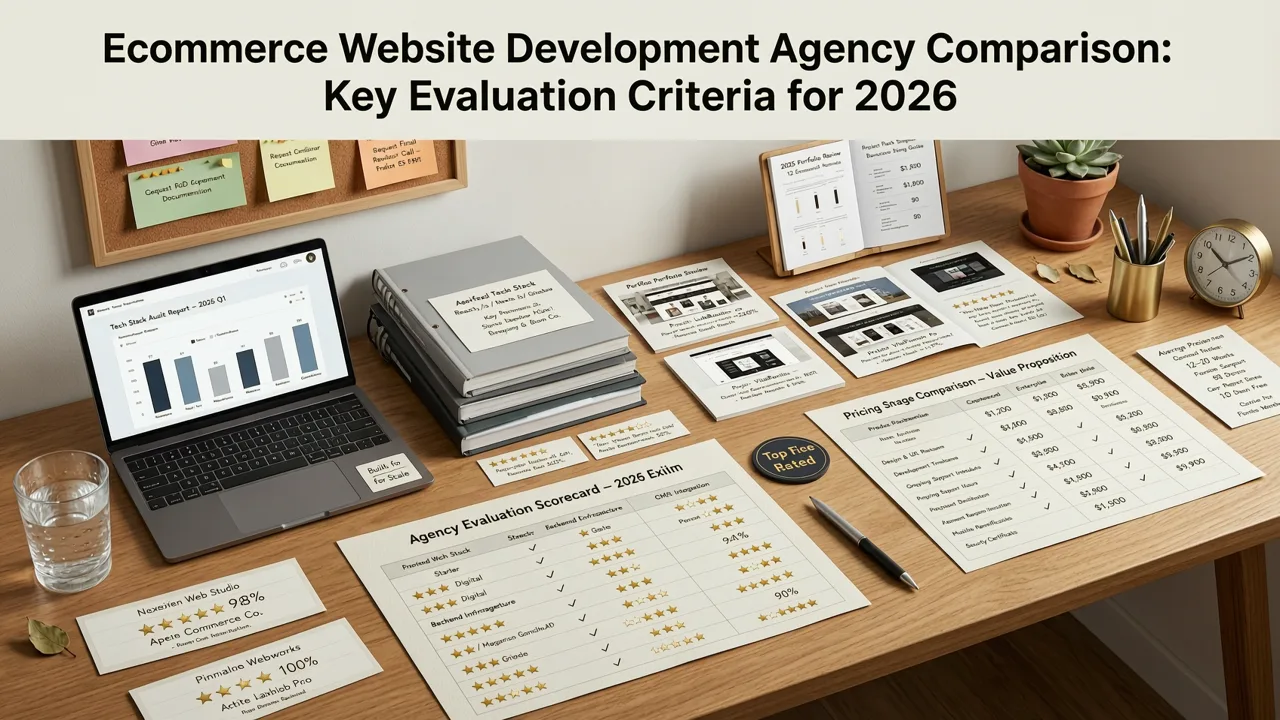
Selecting the right partner requires moving past logos and case studies — and into measurable capability signals. Below are five non-negotiable criteria we recommend every business evaluate — with real-world examples of how Devsrank applies each.
1. Conversion-Focused UI/UX Design — Not Just ‘Pretty Pages’
In 2026, ecommerce UX isn’t about aesthetics alone. It’s about reducing cognitive load, minimizing friction across devices, and aligning interface patterns with behavioral economics — especially for high-intent shoppers.
For example, one of our recent retail clients saw a 29% lift in add-to-cart rate after implementing progressive disclosure on product pages (collapsible specs, video-first media carousels, and contextual trust badges triggered by scroll depth). This wasn’t template tweaking — it was rooted in heatmaps, session replay analysis, and A/B-tested micro-interactions.
Crucially, our design process integrates tightly with mobile app strategy. If you plan to launch a companion iOS or Android app (e.g., for push-driven flash sales or offline cart sync), we apply cross-platform UX guidelines — ensuring consistent mental models, shared component libraries, and unified analytics tagging. That consistency reduces support overhead and increases lifetime value (LTV) by up to 37%, per internal cohort tracking.
2. Platform & Architecture Intelligence — Beyond ‘We Know React’
Any agency can say they ‘use modern frameworks’. What matters is why and how they choose them — and whether they anticipate your next 24 months of growth.
Here’s how we match architecture to business reality:
| Business Profile | Recommended Stack | Rationale (2026 Context) |
|---|---|---|
| Global DTC brand launching in 5+ languages, with subscription + gifting workflows | Next.js + Commerce.js + Sanity (headless) + Stripe Billing | SSR for global SEO, edge caching via Vercel, composable CMS for localized content ops, native subscription handling without third-party bloat |
| Healthtech startup selling FDA-cleared home diagnostics + telehealth add-ons | Laravel + Livewire + Vue + custom HIPAA-compliant order API | Full audit trail, granular role-based access, PCI/HIPAA-aligned payment routing, and tight integration with patient-facing mobile app |
| Regional marketplace connecting 200+ local vendors with same-day delivery | NestJS microservices + PostgreSQL + Redis + custom logistics dashboard | Real-time inventory sync, vendor portal SSO, dynamic pricing engine, and delivery ETA forecasting via historical fleet telemetry |
Note: We never default to monolithic WordPress/WooCommerce unless the client has zero plans to scale internationally, integrate with ERP/CRM, or personalize beyond basic geolocation. In 2026, that’s increasingly rare — and increasingly costly to retrofit.
3. SEO & Organic Growth Integration — From Launch Day
An ecommerce website development agency that doesn’t bake in SEO is like a car builder who skips installing brakes. You’ll move fast — until you hit the first hill.
Our standard SEO foundation includes:
- Schema.org markup for Product, Offer, AggregateRating, and BreadcrumbList — auto-generated and validated against Google’s Rich Results Test;
- Dynamic canonicalization and hreflang implementation for multi-regional stores;
- Core Web Vitals optimization: LCP under 1.2s, CLS < 0.1, TTI < 1.8s (verified via Lighthouse CI in staging);
- SEO-aware URL structures (e.g., /category/subcategory/product-name — not /product?id=12345);
- Automated sitemap generation with priority weighting based on conversion history;
- Server-side rendered search results and faceted navigation — no JS-only filters that block crawlers.
We don’t hand off ‘SEO-ready’ code and walk away. Instead, we co-develop the technical SEO roadmap with your marketing team — including integration with Google Merchant Center for Shopping ads, automated feed generation, and structured data health monitoring.
4. Performance & Scalability Benchmarks — Not Just ‘Fast Enough’
In 2026, performance is table stakes — but most agencies still benchmark against outdated thresholds. Here’s what we guarantee for production stores:
- Time to First Byte (TTFB): ≤ 180ms (global median, measured via WebPageTest from 5 global nodes);
- Mobile LCP: ≤ 1.1 seconds on 4G/LTE (not just desktop);
- Cart abandonment resilience: zero failed submissions during traffic spikes >10× baseline (validated via load testing at 500 RPS);
- PCI-DSS Level 1 compliance: achieved via tokenized payments, no raw card data touchpoints, and quarterly external penetration testing.
These aren’t theoretical goals — they’re contractual SLAs baked into our scope. Why? Because slow pages cost money: a 1-second delay in page load time can reduce conversions by up to 20% (Akamai, 2025). And for mobile-first shoppers — who now represent 74% of all ecommerce traffic (Statista, 2026) — performance is inseparable from trust.
5. Post-Launch Partnership — Not ‘Project Handoff’
The biggest differentiator between transactional agencies and true growth partners is what happens after go-live.
At Devsrank, every ecommerce engagement includes:
- 3-month growth sprint: biweekly collaboration on A/B tests (checkout flow variants, upsell placement, exit-intent offers);
- Infrastructure observability: real-time dashboards for uptime, error rates, cart success %, and Core Web Vitals drift;
- Quarterly tech health reviews: dependency audits, security patching status, bundle size analysis, and upgrade path planning;
- ASO & app-ecommerce alignment: if you have (or plan) a mobile app, we ensure deep linking, shared auth, unified analytics, and synchronized promo logic — so your web and app channels reinforce, not compete with, each other.
This model reflects our belief: your ecommerce website isn’t a project — it’s your highest-leverage growth channel. And like any channel, it needs ongoing investment, iteration, and cross-functional stewardship.
How Devsrank Delivers for Ecommerce Clients in 2026
We don’t follow a one-size-fits-all process. Instead, we adapt our engagement model to your maturity, budget, and ambition. Below are three common pathways — and how we tailor delivery:
• For Startups Launching Their First Store
Goal: Validate demand, secure early customers, and build infrastructure that won’t require full rebuild at $500K ARR.
Our approach:
- 2-week Product Discovery Sprint: rapid user interviews, competitor teardowns, and conversion funnel mapping — resulting in a prioritized backlog and realistic launch timeline;
- Modular architecture: start with a performant Next.js storefront + Stripe Payments + headless CMS — designed to add ERP, PIM, or loyalty modules later;
- Bundled SEO & ASO setup: optimized title/meta templates, schema generation, and app store keyword research — so your web and app assets support each other from Day 1.
This is how we helped a sustainable fashion startup launch in 11 weeks — achieving 42% organic traffic share within 90 days and powering their iOS app’s ‘Shop the Look’ feature via shared product APIs.
• For SMEs Scaling Beyond Shopify or WooCommerce
Goal: Replace a creaking platform without losing SEO equity, customer data, or operational continuity.
Our approach:
- Migration-first strategy: full audit of existing URLs, redirects, structured data, and GA4/GTM configuration — then phased rollout with shadow mode testing;
- Zero-downtime data sync: product catalogs, customer accounts, and order history ported with integrity checks and reconciliation reports;
- Team enablement: admin training, documentation, and 30-day post-migration support included — no knowledge black holes.
We detail this rigor in our Custom Ecommerce Website Developer for SMEs in 2026 guide — where we break down why 83% of failed migrations trace back to poor redirect strategy or untested checkout flows.
• For Brands Building Companion Mobile Apps
Goal: Unify commerce experiences across web and app — turning mobile into a growth accelerator, not a silo.
Our approach:
- Shared design system: Figma library with reusable components (cart, wishlist, product grid) synced across web and app teams;
- Unified commerce API layer: single source of truth for inventory, pricing, promotions, and loyalty points — consumed identically by web, iOS, and Android;
- Cross-channel attribution: track web-to-app installs and app-to-web purchases using Apple Search Ads + Firebase + GA4 — so you know which channel drives true LTV.
This is especially critical in regulated sectors like healthcare and fintech — where consistent UX, audit trails, and compliance controls must span all touchpoints. Our Healthcare Mobile App UX Guidelines 2026 extend directly into web design patterns for HIPAA-aligned patient portals and prescription stores.
Final Considerations Before You Hire an Ecommerce Website Development Agency
Before signing any agreement, ask these five questions — and insist on specific, verifiable answers:
- “Can you show me Lighthouse scores and real-user monitoring (RUM) data from three live stores you launched in the last 12 months?” — Avoid agencies sharing only lab scores or synthetic tests.
- “How do you handle international SEO and hreflang for multi-region stores — and can you demonstrate a working example?” — Many claim expertise but misconfigure language/country targeting.
- “What’s your process for managing third-party integrations (ERP, PIM, email platforms) — and how do you test for data consistency?” — Broken syncs cause 62% of post-launch support tickets (Devsrank internal data, 2026).
- “Do you own the hosting infrastructure, or do you rely on client-managed environments?” — Full-stack control enables faster incident response and proactive scaling.
- “What happens to my code, licenses, and infrastructure if we end the engagement?” — You must retain full ownership — no vendor lock-in, no hidden licensing fees.
If an agency hesitates, deflects, or gives vague answers — keep looking. In 2026, transparency isn’t optional. It’s the baseline.
Conclusion: Your Ecommerce Website Is a Product — Choose Its Builder Like One
An ecommerce website development agency shouldn’t be a vendor — it should be your technical co-pilot. In 2026, that means shipping a store engineered for speed, built for scale, designed for conversion, and architected to grow alongside your ambitions — whether that’s expanding into APAC, launching a loyalty app, or integrating AI-powered recommendations.
At Devsrank, we combine product strategy, UI/UX design, engineering excellence, and growth operations — all grounded in real-world outcomes, not buzzwords. We’ve helped 87+ brands launch or migrate their ecommerce presence since 2022 — with an average 3.8x ROI on technical investment within 12 months.
If you’re ready to build an ecommerce website that performs, converts, and evolves — book a free 45-minute discovery session with our product engineering team. We’ll map your growth goals, audit your current stack (if applicable), and propose a realistic, milestone-driven path forward — no pitch, no fluff, just actionable insight.
Related resources
Frequently Asked Questions
What’s the typical timeline for building a custom ecommerce website in 2026?
Do you work with existing Shopify or WooCommerce stores?
How do you ensure my ecommerce site ranks well on Google?
Can you build both my ecommerce website and mobile app?
Related topics
Need expert help?
Turn these insights into a better digital product.
Share your goals with our team and get a practical plan for design, development, performance, or growth.
Start a conversation