Why Startups Need a Specialized E-Commerce Website Developer in 2026

If you are launching a product-led startup in 2026, your website is not a brochure — it is your storefront, your conversion engine, and often your first real employee. Choosing the right e-commerce website developer for startups can be the difference between a store that scales past seven figures and one that stalls at launch because of slow load times, poor mobile UX, or a platform that cannot handle your growth.
The short answer: a startup-focused e-commerce developer combines speed-to-market with architectural decisions that keep total cost of ownership low, organic visibility high, and checkout friction near zero. Below is a practical, no-fluff guide to what that actually looks like — and how to pick the right partner.
What an E-Commerce Website Developer for Startups Actually Does
A generalist web designer builds pages. A startup-focused e-commerce developer builds revenue systems. Here is what the engagement typically covers:
- Product strategy & architecture: mapping SKUs, variants, bundles, subscriptions, and digital products into a clean data model.
- Platform selection: Shopify Plus, headless commerce, or a fully custom stack — chosen based on your growth curve, not the developer's preference.
- UI/UX design: mobile-first, conversion-focused interfaces tested against 2026 checkout expectations (one-tap pay, progressive profiling, AI-assisted search).
- Performance engineering: sub-2-second Largest Contentful Paint, Core Web Vitals in the green, and edge-rendered pages.
- SEO & ASO foundation: structured data, faceted navigation hygiene, image optimization, and merchant feed setup.
- Launch & growth support: analytics, A/B testing, email automation, and post-launch iteration.
At Devsrank, we treat every e-commerce build as a product — not a project — because startups that treat their store as a living product consistently outgrow those that do not.
Shopify vs Custom Build: The 2026 Decision Framework
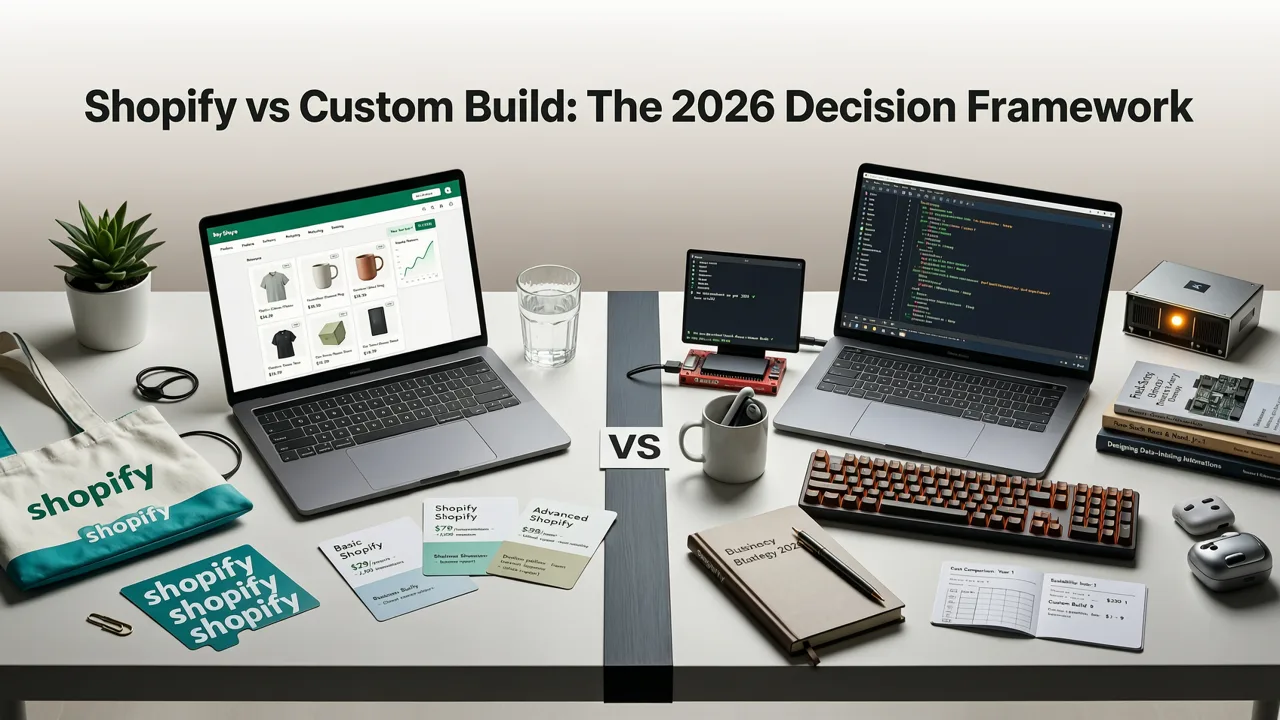
The most common question founders ask is whether to launch on Shopify or commission a fully custom e-commerce website. In 2026, the honest answer depends on three variables: your time-to-market pressure, your expected SKU complexity, and your long-term brand differentiation needs.
When Shopify Is the Right Call
Shopify remains the fastest path to revenue for most startups. If you need to validate product-market fit in under six weeks, Shopify's managed infrastructure, 10,000+ app ecosystem, and built-in checkout conversion tools are hard to beat. It is also the safer choice when your team is small and you do not have an in-house engineer to maintain a custom stack.
When Custom Is the Right Call
Custom e-commerce makes sense when your product is inherently differentiated — think configurable goods, marketplace dynamics, B2B pricing tiers, or deeply interactive product experiences. It also wins when you need full control over SEO architecture, page-speed budgets, and data ownership.
For a deeper breakdown with real cost comparisons, read our Shopify vs Custom Ecommerce Website in 2026 guide.
| Criteria | Shopify (Headless or Standard) | Custom E-Commerce Build |
|---|---|---|
| Time to launch | 2–6 weeks | 8–16 weeks |
| Monthly platform cost | $39–$2,300+ | Hosting only ($20–$300) |
| Checkout customization | Limited (Plus unlocks extensibility) | Fully custom |
| SEO control | Good, with constraints on URL structure | Complete |
| Best for | DTC brands, fast validation | Marketplaces, B2B, complex catalogs |
| 3-year TCO (typical startup) | $25K–$90K | $40K–$150K |
The Fastest Website Development Frameworks for E-Commerce in 2026
If you are leaning toward a custom or headless build, the framework you choose determines your ceiling for speed, SEO, and developer productivity. In 2026, the leading options are:
- Next.js (React): the balanced choice for agencies and startups that want server components, streaming SSR, and a mature e-commerce ecosystem.
- Astro: the speed king for content-heavy storefronts and marketing sites that feed into a commerce backend.
- Remix: excellent for nested layouts and real-time inventory experiences.
- SvelteKit: a rising option for teams that want smaller bundles and simpler reactivity.
Each framework has trade-offs. For a detailed technical comparison, see our Fastest Website Development Frameworks in 2026 resource.
Conversion-Centric UI/UX: What 2026 Shoppers Expect
Conversion rate is not a design afterthought — it is an architectural input. In 2026, mobile shoppers expect the following as baseline:
- Sub-2-second page loads on 4G connections, measured by LCP and INP.
- One-tap checkout via Shop Pay, Apple Pay, Google Pay, or PayPal Fastlane.
- AI-powered search that understands natural language queries like "red leather crossbody under $100."
- Progressive product pages that load above-the-fold content instantly and lazy-load reviews, videos, and recommendations.
- Accessible, inclusive design that meets WCAG 2.2 AA as a baseline — not a nice-to-have.
A startup-focused e-commerce developer will bake these patterns into the design system from day one, not retrofit them six months later.
SEO & Merchant Feeds: The Organic Growth Layer
Most startup e-commerce sites underinvest in SEO until they hit a growth plateau. The smarter move is to build SEO into the foundation. That means:
- Automatic generation of unique, keyword-rich title tags and meta descriptions for every product, collection, and blog post.
- Clean faceted navigation with canonical tags and crawl-budget management.
- Schema markup for Product, Offer, Review, and FAQ — validated through Google Merchant Center for Shopping visibility.
- Optimized image pipelines using next-gen formats (AVIF, WebP) and responsive srcsets.
- A blog and content strategy tied to informational and commercial-intent keywords in your niche.
If you are also planning a mobile app, your e-commerce SEO work compounds when paired with app store optimization. Our team covers both disciplines under one roof.
How to Choose the Right E-Commerce Website Developer for Your Startup
Not every agency that says "we build e-commerce sites" is equipped to ship a startup-grade store. Use this checklist when evaluating partners:
- Startup experience: have they shipped stores for founders, not just enterprise brands?
- Platform depth: can they advise on Shopify, headless, and custom — or do they only push one stack?
- Performance proof: ask for Lighthouse scores, Core Web Vitals data, and real conversion lift case studies.
- SEO & ASO capability: organic growth should be part of the build, not an afterthought.
- Post-launch support: startups iterate fast. You need a partner who ships weekly, not quarterly.
- Transparent pricing: fixed-scope milestones or clear time-and-materials caps — no surprise invoices.
For a more detailed evaluation framework, check out our guide on How to Choose a Mobile App Developer in 2026 — the same principles apply to e-commerce website partners.
What a Typical Startup E-Commerce Engagement Looks Like
Here is a realistic timeline for a startup working with an experienced e-commerce developer in 2026:
| Phase | Duration | Deliverables |
|---|---|---|
| Discovery & strategy | 1–2 weeks | Product architecture, platform recommendation, roadmap |
| UI/UX design | 2–3 weeks | Wireframes, high-fidelity mockups, design system |
| Development sprint 1 | 3–4 weeks | Core storefront, product pages, cart, checkout |
| Development sprint 2 | 2–3 weeks | Integrations (ERP, 3PL, email, analytics), SEO setup |
| QA & launch | 1 week | Performance audit, accessibility review, soft launch |
| Growth iteration | Ongoing | A/B tests, CRO experiments, feature releases |
Common Mistakes Startups Make With Their E-Commerce Build
After working with dozens of founders, we see the same avoidable mistakes repeat:
- Choosing a platform before understanding the product model. A subscription-heavy brand has different needs than a single-SKU viral product.
- Over-customizing checkout early. Shopify's default checkout converts extremely well — customizing it before you have traffic data is usually a net negative.
- Ignoring mobile performance. In 2026, 70%+ of e-commerce traffic is mobile. If your mobile LCP is above 3 seconds, you are leaving revenue on the table.
- Skipping structured data. Without Product schema, you are invisible to Google Shopping, Bing Shopping, and AI-powered commerce surfaces.
- Building without analytics. Launch without GA4, server-side tracking, and a CRO testing plan, and you are flying blind.
Integrations Every Startup E-Commerce Site Needs in 2026
Your storefront does not live in isolation. A well-scoped integration layer connects your store to the tools that run your business:
- Payments: Stripe, Shop Pay, Apple Pay, Google Pay, Buy Now Pay Later options.
- Fulfillment: ShipStation, Shippo, or a 3PL integration like Deliverr or Flexport.
- Email & SMS: Klaviyo, Postscript, or Omnisend for lifecycle marketing.
- Analytics: GA4 with server-side tagging, plus a product analytics tool like Triple Whale or Northbeam for attribution.
- Customer support: Gorgias, Zendesk, or Intercom with commerce-aware macros.
- ERP / Inventory: NetSuite, Cin7, or TradeGecko for multi-channel stock sync.
A good e-commerce developer will architect these integrations cleanly from day one so that adding a new channel — say, a mobile app or a wholesale portal — does not require a rebuild.
Scaling Beyond the Website: App, Marketplace, and Global Expansion
Most successful e-commerce startups eventually expand beyond a single website. That might mean launching an iOS and Android app, selling on Amazon or regional marketplaces, or localizing for new geographies. The developer you choose today should be thinking about these vectors from the start — even if you are not ready for them yet.
At Devsrank, we support startups across the full lifecycle: from initial e-commerce build, through mobile app development, to international expansion with multi-currency, multi-language, and localized payment methods. Our fintech, healthcare, and on-demand delivery experience means we understand regulated and complex verticals as well.
Frequently Asked Questions
How much does it cost to hire an e-commerce website developer for a startup?
In 2026, a Shopify-based startup store typically costs between $15,000 and $50,000 for design and development. A fully custom headless build ranges from $40,000 to $150,000 depending on complexity. Ongoing maintenance, integrations, and CRO add $2,000 to $8,000 per month.
How long does it take to build a startup e-commerce website?
A Shopify launch can be live in 4 to 6 weeks. A custom or headless build typically takes 10 to 16 weeks from discovery to launch. Timelines compress when product data, brand assets, and integration credentials are ready at kickoff.
Should my startup use Shopify or a custom e-commerce platform?
Use Shopify if you need fast validation, a small team, and standard DTC product models. Choose custom if your product requires complex configurators, marketplace dynamics, B2B pricing, or deep brand differentiation that Shopify's templates cannot deliver.
What makes an e-commerce website developer "startup-focused"?
A startup-focused developer understands rapid iteration, lean budgets, and the need to ship fast without accumulating technical debt. They prioritize conversion, performance, and SEO from day one — and they offer flexible engagement models that match early-stage cash flow.
Ready to Build an E-Commerce Store That Actually Scales?
Choosing the right e-commerce website developer for startups is one of the highest-leverage decisions you will make in your first year. The right partner does not just build a site — they build a revenue engine with the performance, SEO, and UX foundations to compound over time.
If you are a startup founder ready to move fast without cutting corners, let us talk. Our team at Devsrank combines product strategy, UI/UX design, engineering, and growth marketing to ship e-commerce stores — and mobile apps — that convert from day one.
Book a free discovery call today and get a tailored roadmap for your store.
Frequently Asked Questions
How much does it cost to hire an e-commerce website developer for a startup in 2026?
How long does it take to build a startup e-commerce website?
Should my startup use Shopify or a custom e-commerce platform?
What makes an e-commerce website developer startup-focused?
Related topics
Need expert help?
Turn these insights into a better digital product.
Share your goals with our team and get a practical plan for design, development, performance, or growth.
Start a conversation