Shopify vs Custom E-Commerce Website: The 2026 Decision That Shapes Your Growth
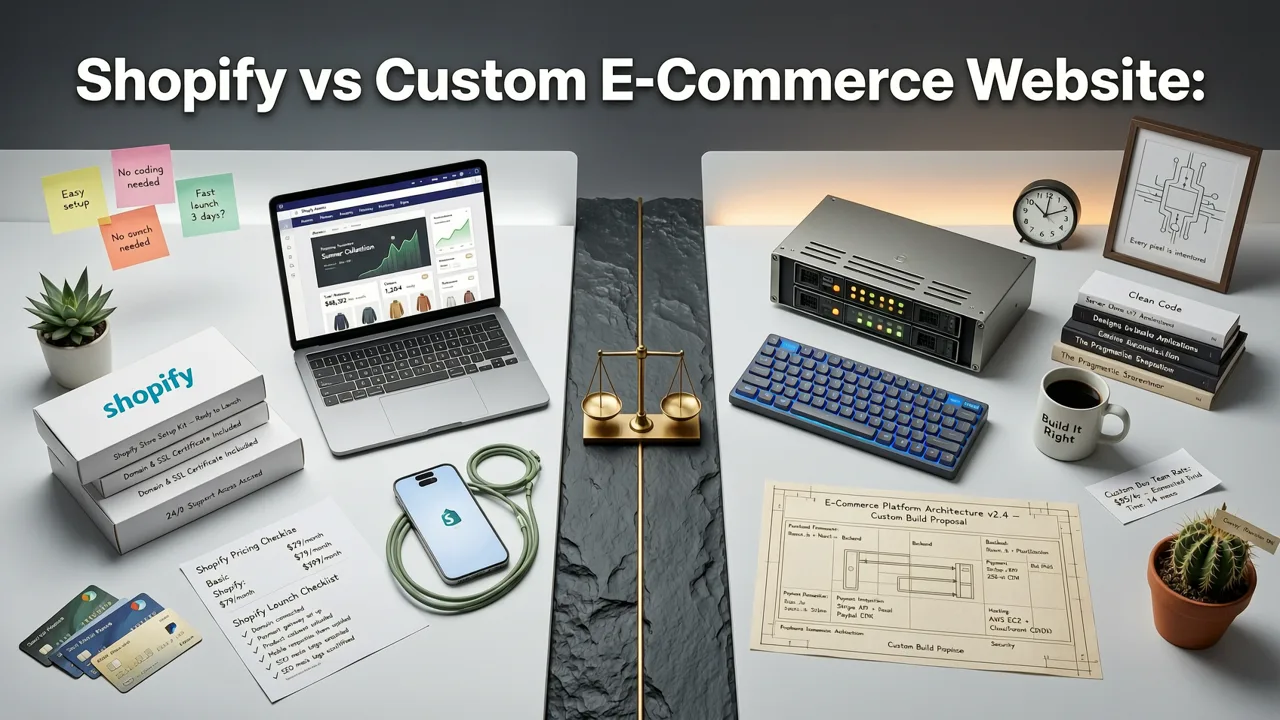
If you're reading this, you're likely weighing a critical decision: should you launch your online store on Shopify, or invest in a custom e-commerce website built from the ground up? In 2026, that choice isn't just about picking a platform—it's about choosing how fast you can iterate, how much you'll spend over time, and how much control you retain over your brand's digital future.
The short answer: Shopify wins on speed-to-market and ease of use, while a custom e-commerce website wins on long-term ownership, flexibility, and SEO control. The right choice depends on your revenue stage, technical capacity, and growth ambitions. Below, we break down every dimension that matters so you can make a confident, data-informed decision.
Shopify vs Custom E-Commerce Website: A 2026 Reality Check
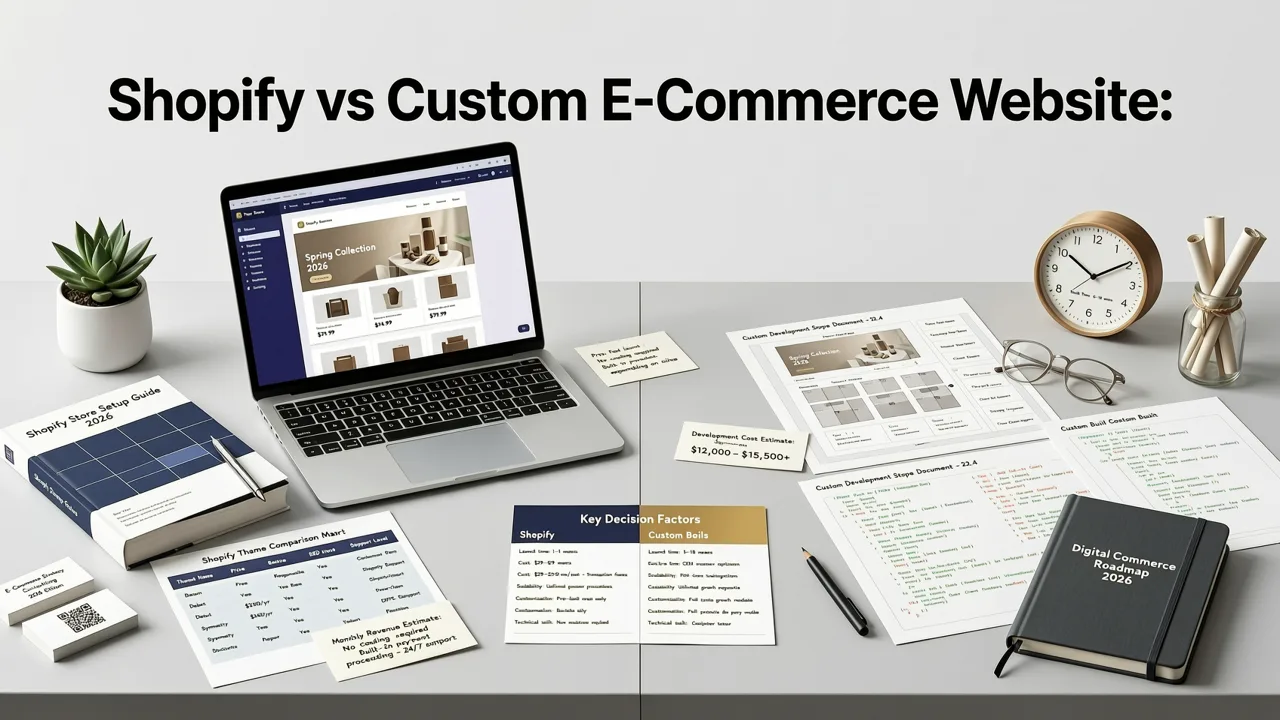
The e-commerce landscape in 2026 looks dramatically different from even two years ago. Headless commerce architectures have matured, AI-driven product recommendations are table stakes, and Google's ranking algorithms reward Core Web Vitals and topical authority more aggressively than ever. Both Shopify and custom-built platforms have evolved to meet these demands—but they serve fundamentally different business models.
Shopify has expanded its ecosystem with Shopify Magic AI tools, deeper Shopify Functions extensibility, and improved B2B capabilities. Meanwhile, custom e-commerce stacks built on frameworks like Next.js, Remix, and Astro now deliver sub-second page loads and pixel-perfect brand experiences that SaaS platforms simply can't match out of the box.
Let's examine the six dimensions that matter most when choosing between the two.
1. Time-to-Market & Launch Velocity

For startups and SMEs racing to validate a product idea, speed is often the single most important factor.
Shopify: Launch in Days, Not Months
Shopify remains the fastest path from concept to live store. With pre-built themes, drag-and-drop editors, and an app ecosystem exceeding 12,000 integrations, most merchants can go live within one to two weeks. Even stores requiring moderate customization—subscription models, multi-currency, or bundled products—can launch within a month using Shopify's native features and vetted apps.
Custom E-Commerce: Built for Complexity, Not Speed
A fully custom e-commerce website typically requires eight to sixteen weeks for an MVP, depending on feature scope. You're trading speed for precision: every user flow, checkout step, and product page is engineered to your exact specifications. If you're building a marketplace, a configurator-heavy product line, or a platform with unique fulfillment logic, that development time is a strategic investment—not wasted effort.
Which Wins?
If your priority is validating demand quickly or launching a seasonal campaign, Shopify is the clear winner. If you're building a differentiated commerce experience that requires bespoke functionality, a custom build is worth the timeline.
2. Total Cost of Ownership Over 3 Years
Cost comparisons often stop at monthly fees. That's a mistake. The real question is total cost of ownership (TCO) over a meaningful horizon—typically three years for growing businesses.
| Cost Factor | Shopify (Advanced/Plus) | Custom E-Commerce Website |
|---|---|---|
| Platform / Hosting | $399–$2,300/month | $50–$300/month (cloud hosting) |
| Theme / Design | $350–$10,000 (one-time) | $15,000–$80,000 (initial build) |
| App / Plugin Fees | $200–$1,500/month | $0 (built-in) or $50–$200/month (SaaS integrations) |
| Transaction Fees | 0%–0.2% (with Shopify Payments) | Payment gateway fees only (≈2.9% + $0.30) |
| Development & Maintenance | $1,000–$5,000/month (agency retainer) | $2,000–$8,000/month (engineering + DevOps) |
| 3-Year Estimated TCO | $50,000–$130,000 | $120,000–$400,000+ |
At lower revenue levels, Shopify's predictable pricing is attractive. But as your GMV scales past $2–5 million annually, Shopify's transaction fees, app stacking costs, and Plus plan premiums compound. A custom e-commerce website's higher upfront cost begins to pay dividends through lower per-transaction overhead and zero platform lock-in.
3. SEO & Organic Visibility Control
Organic search remains the highest-ROI channel for e-commerce brands in 2026. How much control do you have over your SEO destiny on each platform?
Shopify's SEO Strengths and Limitations
Shopify handles the technical fundamentals well: automatic sitemaps, canonical tags, structured data for products, and mobile-responsive themes. However, it imposes structural constraints. URL patterns are partially locked (/products/, /collections/), blog functionality is basic, and server-side rendering customization is limited unless you go headless with Hydrogen.
Custom E-Commerce: Full Technical SEO Ownership
With a custom build, you control every aspect of your SEO architecture. You can implement dynamic rendering strategies, optimize Core Web Vitals at the framework level, create programmatic SEO templates for thousands of landing pages, and structure your internal linking graph exactly as your content strategy demands.
For brands where organic traffic is a primary growth lever, a custom e-commerce website paired with one of the fastest website development frameworks in 2026 delivers a compounding advantage. Page speed, schema markup flexibility, and content architecture all work in your favor.
4. Customization & Brand Differentiation
Your storefront is your brand's digital flagship. How much can you customize it?
Shopify: Constrained but Improving
Shopify's Online Store 2.0 architecture and Shopify Functions have expanded what's possible. Sections, blocks, and metafields give merchants meaningful flexibility. But you're still operating within Shopify's template paradigm. Truly unique interactions—3D product configurators, immersive storytelling pages, real-time customization engines—require heavy Liquid customization or headless setups that diminish Shopify's simplicity advantage.
Custom: No Ceiling on Creativity
A custom e-commerce website imposes zero constraints on your user experience. Every animation, micro-interaction, and checkout flow is engineered to your brand's identity. If your competitive advantage depends on a distinctive digital experience, custom development is non-negotiable.
This is where a strategic mobile app UI UX audit becomes invaluable—ensuring your commerce experience is consistent and conversion-optimized across web and mobile touchpoints.
5. Scalability & Performance Under Load
Black Friday, viral TikTok moments, and flash drops all test your infrastructure. How do the two options compare?
Shopify: Effortless Horizontal Scaling
Shopify's infrastructure handles traffic spikes without any action on your part. During peak sales events, Shopify's global CDN and auto-scaling architecture keep your store fast and stable. You never need to provision servers or optimize database queries. For most merchants, this peace of mind is worth the platform fee.
Custom: Scalable, but You Own the Responsibility
A well-architected custom e-commerce website can match or exceed Shopify's performance—but it requires deliberate engineering. You'll need edge caching, database optimization, CDN configuration, and load testing. The advantage? You can optimize every layer of the stack for your specific traffic patterns and product catalog size.
For high-SKU catalogs (100,000+ products) or complex filtering requirements, a custom solution with a purpose-built search engine (like Algolia or Typesense) often outperforms Shopify's native search capabilities.
6. Integrations, APIs & the Ecosystem Question
No e-commerce platform operates in isolation. Your store connects to ERPs, CRMs, 3PLs, marketing automation, and analytics tools.
Shopify's App Ecosystem
Shopify's app store offers pre-built integrations for nearly every business tool. Setup is typically plug-and-play, and the Shopify developer documentation provides robust APIs for custom integrations via Shopify Functions and the Admin API. However, relying on third-party apps introduces dependency risk—apps can increase in price, change functionality, or be discontinued.
Custom: Build Exactly What You Need
With a custom e-commerce website, every integration is purpose-built or connected via open APIs. You're not limited by what's available in an app store. Need a custom connection to a niche fulfillment provider or a proprietary loyalty engine? Your engineering team builds it. The trade-off is higher development and maintenance cost.
For businesses integrating product listings with Google Merchant Center for Shopping campaigns and free listings, both platforms support robust feed management—though custom builds offer more granular control over feed attributes and optimization.
7. Ownership, Portability & Long-Term Risk
This is the dimension most comparison articles overlook—and it may be the most important.
Shopify: You Rent the Infrastructure
When you build on Shopify, you're building on rented land. Shopify controls the platform roadmap, pricing, terms of service, and API deprecation schedule. Historical precedent shows that platform pricing tends to increase over time, and policy changes can impact entire categories of merchants overnight.
Custom: You Own Everything
A custom e-commerce website means you own the codebase, the hosting infrastructure, and the data. You can migrate hosting providers, switch payment processors, or re-architect your stack without platform permission. For businesses planning for a long-term exit, acquisition, or IPO, owning your technology stack materially increases enterprise value.
When to Choose Shopify in 2026
- You're validating a new product or market: Launch fast, learn quickly, and iterate without heavy upfront investment.
- Your catalog is straightforward: Standard product types, simple variants, and conventional fulfillment.
- You lack an in-house engineering team: Shopify's managed infrastructure removes DevOps burden entirely.
- Speed-to-revenue matters more than brand uniqueness: You need to start generating sales within weeks.
- Your annual GMV is under $2 million: Shopify's cost structure remains competitive at this scale.
When to Choose a Custom E-Commerce Website in 2026
- Your business model is non-standard: Marketplaces, subscription boxes with complex logic, B2B portals, or configurator-heavy products.
- SEO is your primary growth channel: You need full control over technical SEO, site architecture, and content strategy.
- Brand experience is your differentiator: Your competitive moat depends on a unique, immersive digital experience.
- You're scaling past $5 million GMV: Custom builds reduce per-transaction costs and eliminate app stacking fees.
- You need full data ownership: Regulatory requirements, acquisition readiness, or long-term strategic control demand it.
The Hybrid Approach: Headless Shopify
There's a third path gaining significant traction in 2026: headless Shopify. This architecture uses Shopify as the backend commerce engine (handling products, inventory, checkout, and payments) while building a fully custom frontend using modern frameworks.
Headless Shopify gives you the operational simplicity of Shopify's backend with the frontend flexibility of a custom build. It's ideal for brands that need pixel-perfect design control and fast page loads but don't want to rebuild inventory management, payment processing, and order fulfillment from scratch.
The trade-off? Higher development complexity and cost than standard Shopify, plus the need for engineering resources to maintain the frontend. If you're considering this path, working with an experienced agency is critical—review our guide on how to choose a mobile app developer in 2026 for frameworks on evaluating technical partners.
Making the Decision: A Practical Framework
Rather than asking "which is better," ask these five questions:
- What is our current GMV, and what do we project in 18 months? Below $2M, Shopify is likely optimal. Above $5M, custom starts winning on TCO.
- How unique is our commerce experience? If customers could have the same experience on any Shopify store, you may not need custom.
- How important is organic search to our growth strategy? High SEO dependency favors custom or headless.
- Do we have or plan to hire engineering talent? Custom requires ongoing technical resources.
- What's our risk tolerance for platform dependency? If owning your stack matters strategically, go custom.
The best e-commerce platform is the one that aligns with your business model, growth stage, and technical capacity—not the one that's trending on social media.
Final Thoughts: Your Platform Should Serve Your Strategy
The Shopify vs custom e-commerce website debate doesn't have a universal winner. Shopify is an exceptional platform that has helped millions of merchants build successful businesses. Custom e-commerce websites serve brands that need full control, maximum performance, and long-term ownership.
What matters is making an intentional choice based on your specific context—your revenue, your growth ambitions, your technical capacity, and your brand strategy. And whatever you choose, plan to revisit the decision annually. Businesses evolve, and your platform should evolve with them.
Ready to explore which path fits your business? Our team at Devsrank helps startups and growing businesses evaluate, build, and scale both Shopify and custom e-commerce solutions. Read our deeper comparison guide or reach out for a free consultation to map your commerce strategy for 2026 and beyond.
Frequently Asked Questions
Is Shopify better than a custom e-commerce website for small businesses?
How much does a custom e-commerce website cost in 2026?
Can I start with Shopify and migrate to a custom website later?
Does Shopify hurt SEO compared to a custom website?
What is headless Shopify and when should I consider it?
Related topics
Need expert help?
Turn these insights into a better digital product.
Share your goals with our team and get a practical plan for design, development, performance, or growth.
Start a conversation