
How to Choose a Mobile App Developer in 2026
If you are reading this, you are likely weighing a critical decision: which mobile app developer should you trust to build the product that will define your business for the next five years? The short answer is that choosing the right mobile app developer in 2026 comes down to five filters: verified industry expertise, a transparent discovery process, a modern engineering stack, a design team that understands your users, and a post-launch growth partner who stays involved after the App Store submission.
The global app economy has matured past the point where any competent coder can ship a competitive product. In 2026, users expect instant load times, biometric authentication, AI-assisted features, and pixel-perfect accessibility. At the same time, app stores enforce stricter review guidelines, privacy regulations continue to tighten worldwide, and AI-powered tooling has reshaped how fast a good team can move. Picking the wrong developer does not just waste your budget; it can cost you months of relaunch time, a damaged brand reputation, and a codebase so tangled that rebuilding becomes cheaper than fixing.
This guide walks you through a practical, step-by-step framework for evaluating mobile app developers, whether you are a seed-stage startup, a growing SME, or an enterprise team extending into mobile. By the end, you will have a repeatable checklist, the right questions to ask in vendor calls, and a clear sense of which red flags should send you running.
Why the Selection Process Matters More Than Ever in 2026

A decade ago, the barrier to entry in app development was low. A small team could ship a functional MVP in eight weeks and iterate later. That era is over. Today, the average successful consumer app integrates with three to five third-party services on day one, must comply with regional data regulations, and needs to support foldable devices, dynamic island interfaces, and wearable companions.
Three macro trends make the developer selection decision more consequential in 2026 than in any prior year:
- AI is table stakes, not a differentiator. Users now expect intelligent search, personalized feeds, and generative content features as baseline functionality. Your developer must be fluent in on-device ML frameworks and responsible AI integration.
- Regulatory complexity has multiplied. From the EU AI Act to updated HIPAA enforcement guidance and evolving state-level privacy laws in the US, compliance is no longer an afterthought. It must be architected in.
- Cross-platform tooling has matured. Frameworks like Flutter and React Native now deliver near-native performance for 80 percent of use cases, but the remaining 20 percent still demands native Swift and Kotlin expertise. Your developer must help you choose honestly, not based on what is cheapest for them to build.
These forces mean that the developer you pick will shape not just your launch, but your ability to iterate, scale, and comply over a multi-year product lifecycle.
Step 1: Define Your Product Scope Before You Evaluate Anyone
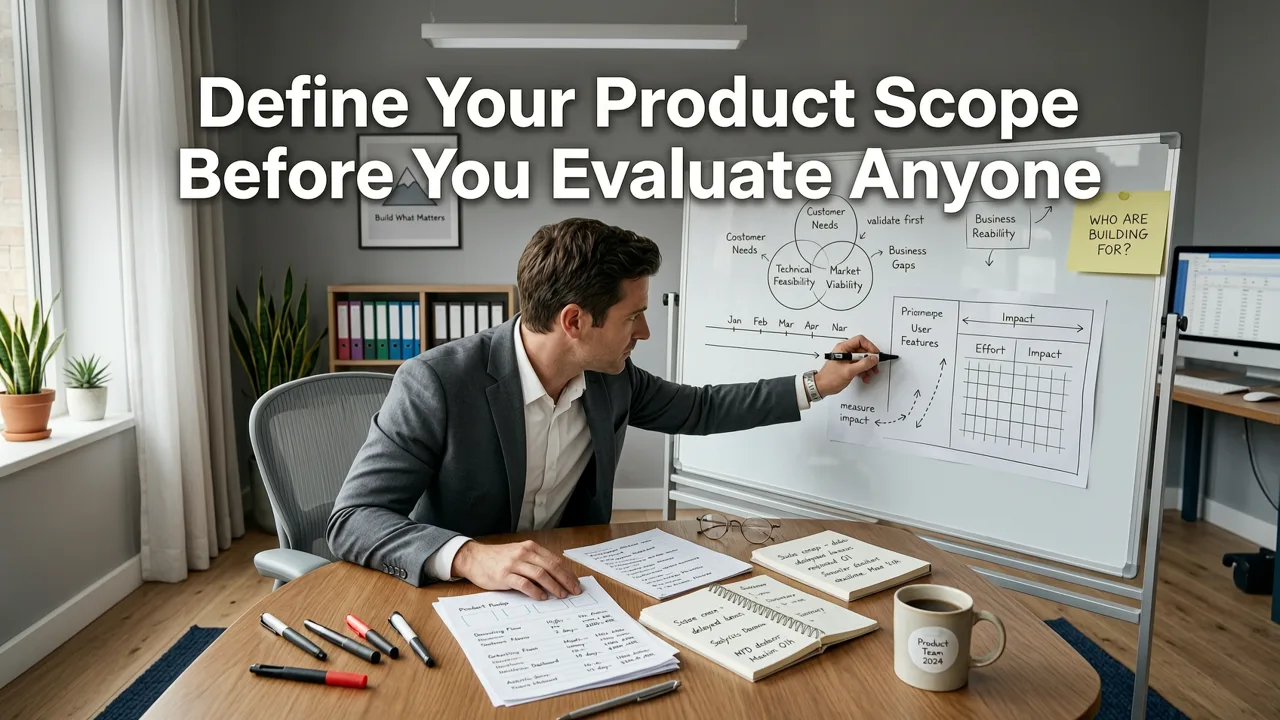
The single most common mistake founders make is shopping for a developer before they know what they are building. You cannot evaluate whether a team is the right fit if you cannot articulate your product vision, target user, core workflows, and success metrics.
Write a one-page product brief
Before you send a single RFP, draft a one-page brief that covers:
- The problem you solve and for whom.
- The primary user jobs-to-be-done.
- The top three to five core features for v1.
- Your target platforms (iOS, Android, both, or web).
- Any regulatory, compliance, or integration requirements.
- Your launch timeline and budget range.
This document becomes your North Star during vendor conversations. Any developer who cannot respond to it with specific, relevant examples is not the right partner.
Classify your app category
App categories have distinct technical and design demands. A fintech app development company will approach security, audit trails, and payment integrations very differently than a team optimized for media streaming. Similarly, a healthcare product demands healthcare app UI/UX design principles that prioritize clinical clarity over visual novelty. Name your category early so you can filter developers by relevant portfolio depth.
Step 2: Evaluate Portfolio Depth, Not Just Portfolio Width
Every agency will show you a gallery of pretty screenshots. The question you need to answer is whether those screenshots represent work the team actually shipped, maintained, and scaled.
Ask for case studies, not just visuals
A strong case study explains the business problem, the technical approach, the trade-offs made, and the measurable outcome. If an agency cannot provide at least two or three case studies in your industry, treat that as a signal.
Download the apps
Install the apps in the portfolio. Test them on your own device. Notice the load times, the error handling, the onboarding flow, and how the app behaves offline. These details reveal engineering maturity far better than any pitch deck.
Check app store ratings and update frequency
An app that has not been updated in over a year is a yellow flag. An app with a 3.2-star rating and unresolved crash complaints is a red flag. You want a developer whose past clients are still shipping, still iterating, and still rated highly by real users.
Step 3: Assess Technical Capability and Stack Choices
In 2026, the technical conversation is no longer just about native versus cross-platform. It is about architecture decisions that determine your ability to scale, integrate AI, and comply with regulation.
Cross-platform versus native: an honest conversation
A trustworthy developer will help you choose the right approach based on your specific product, not push a one-size-fits-all stack. As a reference point, teams evaluating this decision often review insights from a top mobile app development agency in the USA to understand how regional market expectations influence stack selection.
| Consideration | Cross-Platform (Flutter / React Native) | Native (Swift / Kotlin) |
|---|---|---|
| Time to market | Faster for shared-feature apps | Longer, but optimized per platform |
| Performance ceiling | High for most use cases | Highest, required for AR, heavy graphics |
| Platform-specific UX | Good, with customization | Native by default |
| Maintenance cost | One codebase, lower ongoing cost | Two codebases, higher ongoing cost |
| Best fit | SMEs, MVPs, content and commerce apps | Hardware-heavy, AR/VR, high-performance |
Architecture and infrastructure questions to ask
- Do you use a modular, feature-based architecture or a monolithic codebase?
- How do you handle state management and offline-first data sync?
- What is your approach to API versioning and backward compatibility?
- Do you deploy with CI/CD pipelines, and can you show me the setup?
- How do you instrument performance and crash monitoring in production?
Answers to these questions separate teams that build for scale from teams that build for demo day.
AI and machine learning readiness
Ask specifically how the team has integrated on-device ML models, LLM-powered features, or AI-driven personalization in past projects. In 2026, any developer who cannot speak concretely about responsible AI integration, model versioning, and fallback behavior is not ready for production work.
Step 4: Evaluate the Design and UX Process
Great engineering cannot rescue a product with poor user experience. In competitive categories, UX is often the primary differentiator.
Look for a structured discovery phase
A professional team will begin with a discovery sprint that includes user research, competitive analysis, information architecture, and wireframing before any code is written. If a developer jumps straight to visual mockups or code, walk away.
Assess the design team's depth
If you are building a consumer-facing product, the quality of your design hire is as important as the quality of your engineering hire. Founders exploring this often find value in resources on how to hire a UI/UX designer for a startup to understand what separates a production-ready designer from a pixel pusher.
Request a design walkthrough
Ask the team to walk you through a past project from research insights to final screens. Listen for how they talk about user testing, iteration, and accessibility. If they cannot articulate why they made specific design decisions, their process is likely superficial.
Step 5: Understand the Engagement and Pricing Model
Pricing transparency is one of the strongest signals of a mature developer. Beware of teams that cannot or will not give you a clear estimate structure.
Common pricing models in 2026
- Fixed-price discovery + time-and-materials development. The most common and honest model. You lock the discovery scope and budget, then build iteratively with weekly visibility.
- Dedicated team model. You hire a full team (PM, designers, engineers, QA) on a monthly retainer. Best for ongoing product development.
- Fixed-price project. Rarely appropriate for anything beyond a small MVP, because mobile products evolve. Treat fixed-price quotes for large scopes with caution.
What a realistic budget looks like
In 2026, a well-built MVP for a single platform typically starts in the mid-five-figure range and can extend well into six figures depending on complexity, integrations, and compliance requirements. Anyone quoting a full-featured fintech or healthcare app for under twenty thousand dollars is either misunderstanding your scope or planning to cut critical corners.
Step 6: Check Communication, Process, and Cultural Fit
You will spend six to twelve months in close collaboration with this team. Communication quality matters as much as technical quality.
Questions to ask about process
- What project management tool do you use, and will I have live access?
- How often will we have sprint demos or progress reviews?
- Who is my single point of contact, and what is their background?
- How do you handle scope changes and unexpected technical challenges?
- What is your average team tenure, and what is your turnover rate?
Time zone and language alignment
Global teams can offer excellent talent at competitive rates, but only if communication rhythms align with yours. A team that overlaps with your working hours for at least three to four hours per day will outperform a cheaper team that operates on a completely shifted schedule.
Step 7: Verify Post-Launch Support and Growth Capabilities
Launch is the beginning, not the end. The developer you choose should be positioned to support you through App Store and Play Store review processes, performance optimization, feature iteration, and growth marketing.
Store submission and compliance support
Ask how many apps the team has successfully submitted in the past year and what their rejection resolution process looks like. A team that has navigated recent store policy changes will save you weeks of frustration.
ASO and growth support
An increasing number of full-service agencies now bundle App Store Optimization and ongoing growth support with development. This is valuable because the team that built your product understands its architecture and can optimize store listings, screenshots, and keyword strategies with full context.
Long-term maintenance
Confirm whether the team offers maintenance retainers, what is included (OS updates, bug fixes, minor feature work), and how they price ongoing engagements. You want a partner, not a vendor who disappears after invoice.
Red Flags That Should Make You Walk Away
Not every developer who pitches you is the right fit. Watch for these warning signs:
- Guaranteed timelines without discovery. Any team that promises a fixed delivery date before understanding your product is guessing.
- No relevant portfolio. Pretty apps in unrelated categories do not prove capability in yours.
- Refusal to share references. Past clients are the best signal. A team that cannot provide them has something to hide.
- One-person shops claiming enterprise capacity. Freelancers can be excellent, but do not pretend to be a full agency.
- Pushing a single technology regardless of fit. A good developer recommends based on your needs, not their comfort zone.
- Vague or evasive pricing. Transparency here predicts transparency everywhere else.
A Practical Vendor Evaluation Checklist
Use this checklist when comparing your final two or three candidates:
- Can they show two or more case studies in my industry?
- Have they built and maintained apps currently live in the stores with strong ratings?
- Do they offer a structured discovery phase before development?
- Is their technical stack modern, and can they justify their choices?
- Do they have in-house design capability with a clear UX process?
- Is their pricing model transparent and aligned with my budget?
- Do they overlap with my time zone for at least three hours daily?
- Can they provide at least two references I can call?
- Do they offer post-launch support, ASO, and growth services?
- Do I feel confident in the chemistry and communication with the team?
If you can check eight or more of these boxes, you have a strong shortlist. If you can check all ten, you have likely found your partner.
Final Thoughts: Choose a Partner, Not a Vendor
The difference between a good mobile app developer and a great one is not just code quality. It is whether they challenge your assumptions, protect your budget, anticipate problems before they happen, and stay invested in your success long after the launch.
In 2026, with AI features, regulatory complexity, and elevated user expectations reshaping every category, the stakes of this decision are higher than ever. Take the time to evaluate thoroughly, ask the hard questions, and choose a team that treats your product as seriously as you do.
If you are ready to start the conversation, the team at Devsrank combines product strategy, UI/UX design, engineering, and launch support to help startups and growing businesses ship faster and scale sustainably. Reach out to discuss your product vision and see whether we are the right fit to build it together.
Frequently Asked Questions
How much does it cost to hire a mobile app developer in 2026?
Should I choose native or cross-platform app development?
What red flags should I watch for when choosing a mobile app developer?
How long does it take to build a mobile app in 2026?
What should I look for in a mobile app developer's portfolio?
Related topics
Need expert help?
Turn these insights into a better digital product.
Share your goals with our team and get a practical plan for design, development, performance, or growth.
Start a conversation