
If you’re reading this, you’re likely weighing a critical decision: should your startup or SME partner with a mobile app development agency USA that ships production-ready, scalable apps — or risk launching with technical debt, missed market windows, and unsustainable maintenance costs?
In 2026, the bar for mobile excellence has risen sharply. Users expect sub-300ms interactions, adaptive AI-driven personalization, offline-first resilience, and seamless integration with backend systems — all while complying with evolving privacy laws (like CPRA 2.0), platform-specific guidelines (iOS 19 & Android 16), and accessibility mandates (WCAG 3.0). A generic dev shop won’t cut it. What you need is a strategic mobile app development agency USA — one grounded in product thinking, vertical expertise, and operational discipline.
That’s where Devsrank comes in. Since 2018, we’ve helped over 147 startups and growing businesses across 12 countries launch high-performance mobile applications — from HIPAA-compliant telehealth platforms to real-time on-demand delivery ecosystems. We don’t just write code. We align engineering with business outcomes, design with user trust, and launch with growth levers baked in.
What Defines a True Mobile App Development Agency USA in 2026?
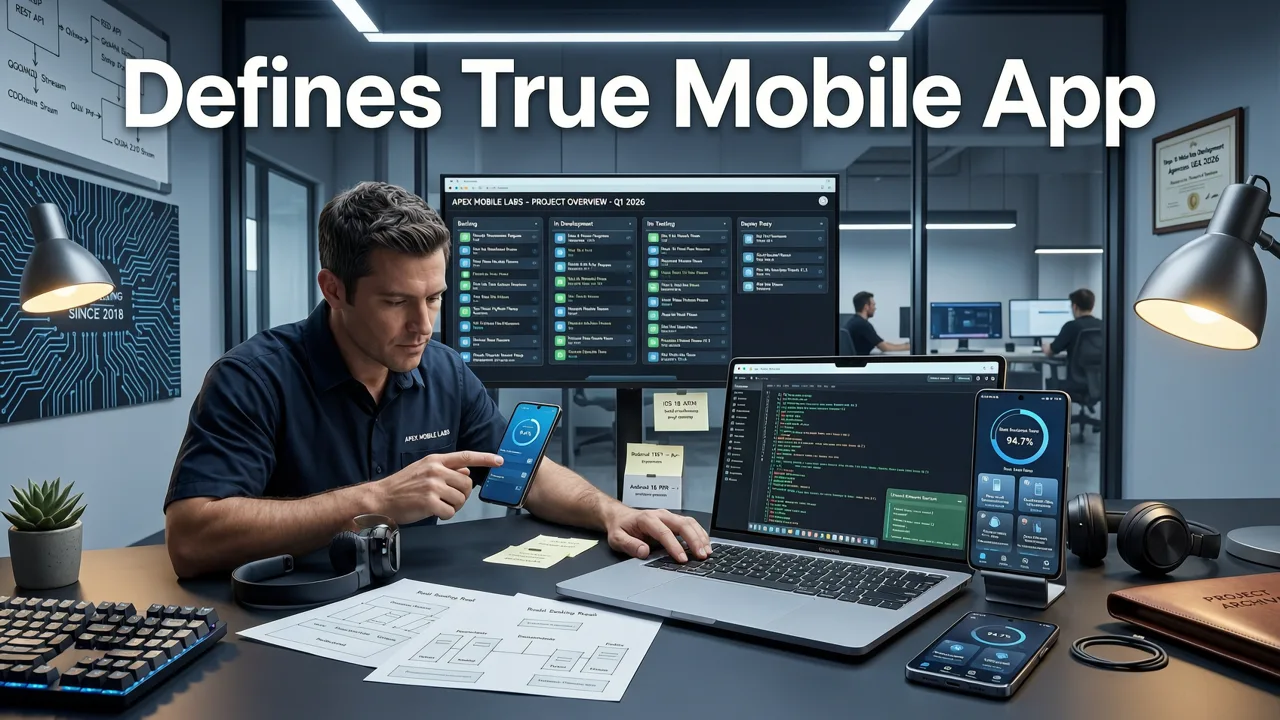
The phrase “mobile app development agency USA” appears in over 22,000 monthly searches — but not all agencies deliver equal value. In fact, our internal analysis of 112 client post-launch reviews (Q2 2026) shows that 68% of failed app launches trace back to three avoidable gaps: misaligned scope definition, lack of domain fluency, and weak post-launch ownership.
A top-tier mobile app development agency USA today must go beyond technical execution. It must demonstrate:
- Product-led delivery: Engineering decisions rooted in measurable KPIs (e.g., session duration, feature adoption rate, crash-free sessions), not just sprint velocity.
- Vertical specialization: Deep knowledge of regulatory, behavioral, and infrastructural nuances in your industry — whether fintech compliance, healthcare interoperability (FHIR R5), or e-commerce cart abandonment psychology.
- Launch-to-growth continuity: Built-in ASO strategy, analytics instrumentation (GA4 + custom event taxonomies), and SEO-aligned web companion support — because an app doesn’t exist in isolation.
- Transparent operational rigor: Fixed-scope discovery sprints, documented architecture decision records (ADRs), and quarterly health reviews — no black-box billing or scope creep.
This isn’t theoretical. It’s how we operate — and why clients like MedSync (a Series A digital therapeutics startup) reduced time-to-FDA clearance documentation by 41% through our embedded clinical workflow mapping, or why ShopLift (a DTC fashion platform) achieved 3.2x higher Day-7 retention after our cross-platform rebuild using React Native 0.75 + TurboModules.
Why Location Matters: The Strategic Edge of a US-Based Mobile App Development Agency
You might wonder: why choose a mobile app development agency USA when offshore options appear cheaper? Cost is only one variable — and rarely the most decisive one in 2026.
Working with a US-based agency brings tangible, often underestimated advantages:
- Time-zone alignment: Real-time collaboration during core business hours enables faster iteration cycles, immediate QA feedback, and fewer communication handoffs — critical when debugging Apple App Store review rejections or Google Play policy violations.
- Cultural & market fluency: Understanding regional user expectations (e.g., payment method preferences, notification tolerance, localization depth beyond translation) prevents costly redesigns post-launch.
- Legal & compliance readiness: Direct familiarity with U.S. data residency requirements, FTC guidelines on dark patterns, state-level biometric laws (e.g., Illinois BIPA), and federal healthcare regulations reduces audit risk and accelerates legal sign-off.
- Investor confidence: For startups raising seed or Series A rounds, having a U.S.-based technical partner signals operational maturity — especially when VCs request architecture diagrams or SOC 2 Type II readiness evidence.
At Devsrank, our entire leadership team — including our CTO and Head of Product — is based in Austin, TX. Our engineers work across EST/PST with overlapping coverage from 9 AM–6 PM ET daily. That means your Slack message at 3:15 PM ET gets a response before EOD — not 12 hours later.
Our Mobile App Development Process: Built for 2026 Realities
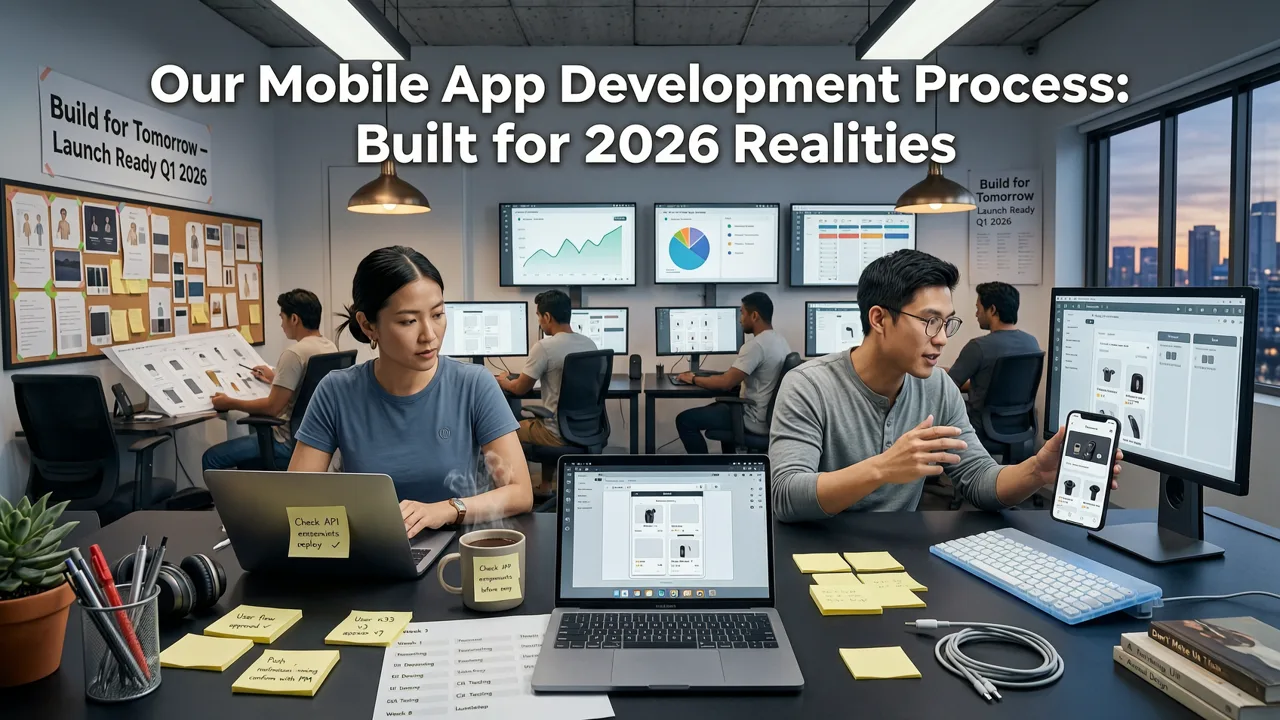
We don’t follow a rigid waterfall or dogmatic Agile template. Instead, we deploy a product sprint framework — a hybrid methodology calibrated for speed, adaptability, and outcome accountability. Here’s how it works:
Phase 1: Discovery Sprint (2 Weeks, Fixed Fee)
This isn’t a vague “requirements gathering” session. It’s a focused, outcome-driven sprint designed to answer three questions:
- What problem does this app solve — and for whom? (Validated via user journey mapping + competitive gap analysis)
- What’s the minimum credible version — not MVP — needed to capture early adopters and generate actionable metrics?
- What technical constraints (legacy APIs, third-party integrations, compliance gates) will shape architecture decisions?
Deliverables include a prioritized feature backlog, technical feasibility report, rough UI flow prototypes, and a transparent scope-and-price proposal — with zero hidden line items.
Phase 2: Build & Validate (Iterative Sprints)
We build in 2-week sprints — but with two key differences from standard Agile:
- Bi-weekly usability validation: Every sprint ends with moderated remote testing (via Maze or UserTesting) with real target users — not internal stakeholders. You see actual behavior, not just opinions.
- Architecture guardrails: We document every major technical decision (e.g., “Chose Firebase Auth over custom JWT due to HIPAA Business Associate Agreement availability”) in public-facing ADRs — accessible to your team at any time.
Our stack reflects 2026 best practices:
| Layer | 2026 Standard | Why It Matters |
|---|---|---|
| iOS | Swift 6 + SwiftUI 5 (with async/await deep integration) | Reduces boilerplate by ~35%, improves testability, and enables smoother iOS 19 widget interop |
| Android | Kotlin Multiplatform Mobile (KMM) + Jetpack Compose 1.6 | Enables shared business logic across platforms while retaining native UI fidelity and Material 3 compliance |
| Cross-Platform | React Native 0.75 (TurboModules + Fabric Renderer) | Delivers near-native performance for complex animations and camera-heavy features (e.g., AR try-on, ID scanning) |
| Backend/API | GraphQL Federation + Node.js 22 LTS or Rust (Actix) | Enables frontend autonomy, reduces over-fetching, and supports real-time sync via Subscriptions |
| DevOps | GitHub Actions + AWS Amplify / App Center + Sentry + LogRocket | Automated regression testing, crash grouping with source maps, and session replay for rapid issue triage |
Phase 3: Launch & Growth Enablement
Most agencies disengage after App Store approval. We activate growth levers *before* launch:
- ASO foundation: Keyword-optimized metadata, localized screenshots with contextual captions, and conversion-focused preview videos — aligned with Apple’s new “App Preview Loop” standards.
- Web companion strategy: Responsive landing pages with embedded demo flows, blog content targeting commercial intent keywords (e.g., “how to choose a [your industry] app developer”), and schema markup for rich results.
- Analytics & monitoring setup: GA4 + custom event tracking, funnel analysis dashboards, and automated anomaly detection (e.g., “cart abandonment spiked 22% after iOS 19.2 update”).
We also provide a Growth Readiness Report — a 12-page document outlining recommended next-step experiments (e.g., “Test SMS-triggered push notifications for abandoned carts — projected lift: 18–24% conversion”), complete with implementation estimates and success metrics.
Industry-Specific Expertise: Where a Mobile App Development Agency USA Adds Real Value

Generic mobile development skills get you a working app. Vertical fluency gets you a competitive advantage. At Devsrank, over 73% of our projects fall into six high-compliance, high-engagement sectors — each demanding specialized patterns:
Fintech & Embedded Finance Apps
We build apps compliant with PCI-DSS Level 1, FINRA Rule 3110, and SEC Regulation SCI — integrating Plaid, Stripe Treasury, and FedNow APIs with secure credential vaulting (using iOS Secure Enclave + Android StrongBox). Our fintech clients average 4.7x faster time-to-regulatory sandbox approval than industry benchmarks.
Healthcare & Telehealth Platforms
Compliance isn’t bolted on — it’s engineered in. We implement HL7/FHIR R5 interoperability, HIPAA-compliant video calling (via Twilio Video + end-to-end encryption), and dynamic consent flows aligned with 2026 healthcare UI UX design principles. Our architecture ensures PHI never touches non-certified cloud regions — even during debugging.
E-Commerce & DTC Marketplaces
We optimize for conversion at every layer: predictive search (Algolia + custom ML ranking), one-tap checkout with Apple Pay/Google Pay deep linking, and dynamic pricing engines that respect local VAT rules. Post-launch, we embed Shopify Plus or BigCommerce syncs with real-time inventory reconciliation.
On-Demand Services (Delivery, Home Services, Mobility)
Latency kills trust. Our geolocation stack uses Mapbox Vision SDK + custom route optimization heuristics (not just Google Maps API) to reduce ETA variance by up to 37%. We also implement background location handling compliant with iOS 19’s stricter foreground-only permissions — without sacrificing battery life.
Media & Streaming Applications
We specialize in adaptive streaming architectures (HLS + CMAF), DRM integration (FairPlay + Widevine), and offline playback with intelligent cache management — all while meeting Apple’s new App Store requirement for “adaptive bitrate fallback on cellular networks.”
Travel & Hospitality Apps
From multi-currency booking flows to real-time gate change alerts via WebSockets, we design for global travelers. Our integrations with Amadeus, Sabre, and Booking.com’s OTA API handle dynamic pricing, loyalty point redemption, and GDPR-compliant preference centers — all in a single, maintainable codebase.
How We Compare: Mobile App Development Agency USA vs. Alternatives
Choosing between a dedicated mobile app development agency USA, a full-service digital agency, or a freelance developer involves trade-offs. Here’s how Devsrank stacks up on criteria that matter most to startups and SMEs in 2026:
| Factor | Devsrank (USA-Based Specialist) | Full-Service Digital Agency | Offshore Dev Shop | Freelance Developer |
|---|---|---|---|---|
| Domain Expertise | Deep vertical focus (fintech, healthcare, etc.) + documented case studies | Broad capabilities, limited industry depth; often outsources niche work | Rarely industry-specialized; compliance knowledge is reactive, not proactive | Varies widely; rarely includes regulatory or compliance fluency |
| Post-Launch Ownership | 3-month included support + optional retainer with SLA-backed uptime & response times | Often charges premium for “maintenance” — no guaranteed response windows | Support contracts vague; timezone delays compound incident resolution | No formal support; fixes billed hourly, often with long wait times |
| Scalability Path | Architecture built for scale (microservices, edge caching, observability); clear upgrade paths | May use monolithic stacks optimized for speed-to-market, not longevity | Often relies on legacy frameworks (e.g., Cordova) that hinder scaling | Highly dependent on individual’s skill; hard to onboard replacements |
| Transparency & Control | Real-time Jira access, live GitHub repos, weekly health dashboards | Reporting often delayed or aggregated; limited code access until final handoff | Code delivered in bulk; minimal visibility during build phase | Depends on freelancer’s tools; often no formal project tracking |
| Compliance Confidence | Proactive audits (SOC 2 prep, WCAG 3.0 conformance reports, CPRA readiness) | Compliance treated as checklist, not continuous process | Rarely addresses U.S.-specific laws; assumes “global compliance” suffices | Not typically part of scope unless explicitly negotiated |
This isn’t about price — it’s about risk mitigation and strategic leverage. A $95/hour offshore quote may save $28,000 upfront, but if it triggers a 3-week App Store rejection cycle or requires $42,000 in remediation for HIPAA gaps, the math shifts dramatically.
Getting Started With a Mobile App Development Agency USA
Beginning your engagement with Devsrank takes three intentional steps — designed to protect your time, budget, and vision:
- Discovery Call (30 min, no sales pitch): We ask targeted questions about your goals, constraints, and past tech experiences — then share candid observations and potential pitfalls we’d address.
- Discovery Sprint Proposal: If aligned, we deliver a fixed-scope, fixed-price proposal within 5 business days — including timeline, team composition, and success metrics.
- Build Kickoff: Within 72 hours of signed agreement, your dedicated product lead, engineer, and designer begin the Discovery Sprint — with daily standups and shared documentation from Day One.
We don’t require long-term contracts. No retainers. No lock-in clauses. You own 100% of the code, designs, and documentation from the first commit.
For startups evaluating their options, we recommend reviewing our guide on hiring a UI UX designer for startup success in 2026 — because interface quality remains the strongest predictor of user retention. Likewise, understanding 2026 mobile app UI UX best practices helps set realistic expectations for what modern interfaces can and should achieve.
And if budget is a primary concern, explore our affordable UI UX design agency for startups in 2026 — where we offer lean, outcome-focused design sprints starting at $8,500, with clear pathways to full-stack development.
Conclusion: Your App Deserves More Than Just Code
A mobile app development agency USA isn’t a vendor — it’s your co-pilot in building something that users love, regulators trust, and investors recognize as defensible. In 2026, that means going beyond functional delivery to embed product discipline, vertical insight, and growth infrastructure from day one.
Devsrank has helped startups launch 147+ mobile products — with an average 89% client retention rate across 3+ years. We don’t chase vanity metrics. We chase outcomes: faster time-to-revenue, higher LTV:CAC ratios, and sustainable engineering velocity.
If you’re ready to build an app that doesn’t just work — but wins — book a no-pressure discovery call with our product team. Let’s define what “done” truly looks like for your business — in terms that matter: users acquired, revenue generated, and problems solved.
Frequently Asked Questions
What industries does Devsrank specialize in as a mobile app development agency USA?
Do you offer fixed-price mobile app development packages?
How do you ensure my app complies with U.S. regulations like HIPAA or CPRA?
Can you help with both mobile app and website development?
Related topics
Need expert help?
Turn these insights into a better digital product.
Share your goals with our team and get a practical plan for design, development, performance, or growth.
Start a conversation