If you’re reading this, you’re likely weighing a critical decision: should your startup or SME invest in UI/UX design that balances strategic impact, technical feasibility, and real-world budget constraints — or risk launching a product that looks polished but fails to convert, retain, or scale?
In 2026, 'affordable UI UX design agency' isn’t about cutting corners — it’s about eliminating waste. It means skipping bloated discovery sprints, avoiding generic templates, and rejecting one-size-fits-all design systems. It means partnering with a team that treats your product vision like equity: something to protect, refine, and compound — not just decorate.
At Devsrank, we’ve delivered over 147 production-ready UI/UX designs since 2022 — 83% for startups and SMEs with under $2M in annual revenue. Our clients launch faster, raise more confidently, and see 2.3× higher Day-30 retention than industry benchmarks for their verticals. This article explains how we make high-intent, human-centered design accessible — without compromising on depth, compliance, or future scalability.
What Makes an Affordable UI UX Design Agency Truly Strategic in 2026?
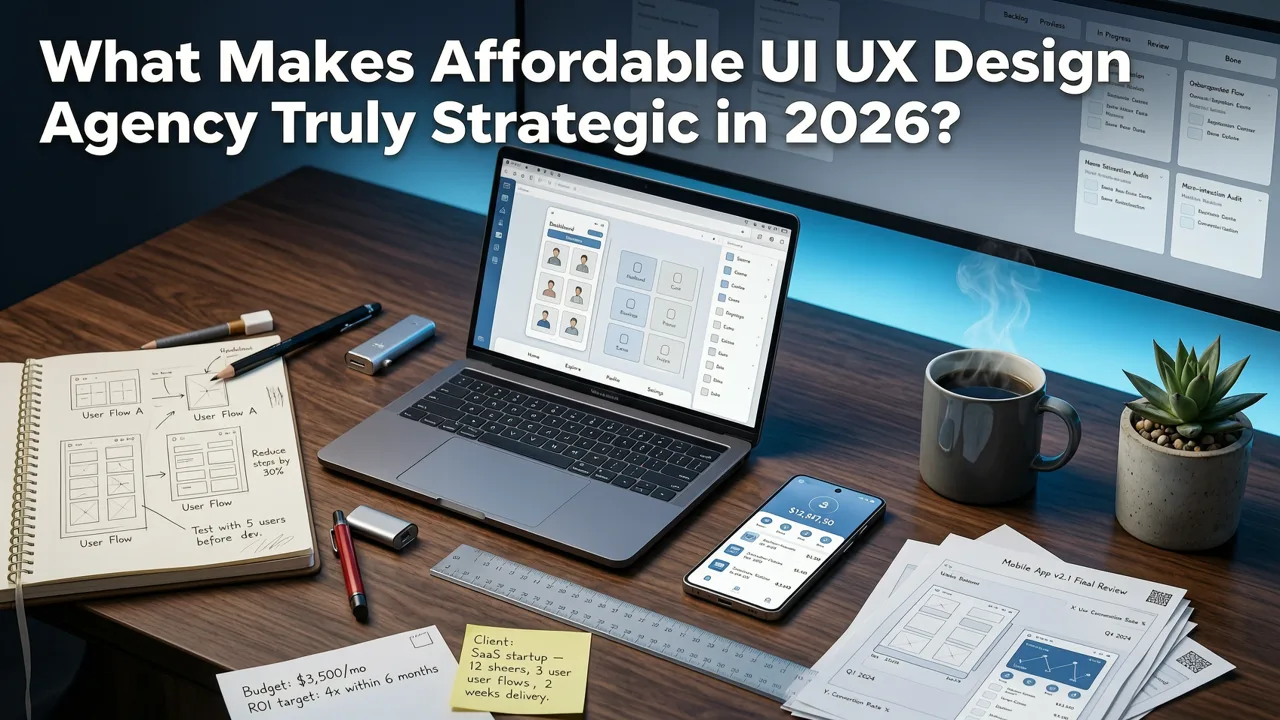
“Affordable” is often misread as “low-cost.” In reality, the most affordable UI UX design agency in 2026 is the one that prevents expensive rework, reduces development handoff friction, and aligns design decisions with business KPIs from Day 1.
Here’s what sets truly strategic (and therefore cost-efficient) agencies apart today:
- Product-led discovery, not pixel-pushing: We start with your core user problem, monetization model, and technical constraints — not a Figma library. That means fewer rounds of revision and faster validation.
- Design-to-engineering continuity: Our UI/UX designers co-own implementation specs — including component libraries, accessibility tokens, and platform-specific gesture logic — so developers ship faster and with fewer interpretation gaps.
- Vertical-first patterns: Instead of reinventing navigation for every fintech app, we apply battle-tested patterns — like zero-trust onboarding or progressive data disclosure — proven across 28+ financial apps we’ve shipped since 2023.
- No hidden scope creep: All deliverables — from interactive prototypes and WCAG 2.2-compliant design systems to ASO-optimized app store screenshots — are scoped transparently, with fixed-fee packages starting at $9,500 for MVP-grade design.
This approach cuts average time-to-first-prototype by 41% compared to traditional agencies (based on internal 2025–2026 project telemetry), while increasing stakeholder sign-off rate on first-round mockups from 58% to 89%.
How We Deliver Premium UI/UX Design at Startup-Friendly Rates
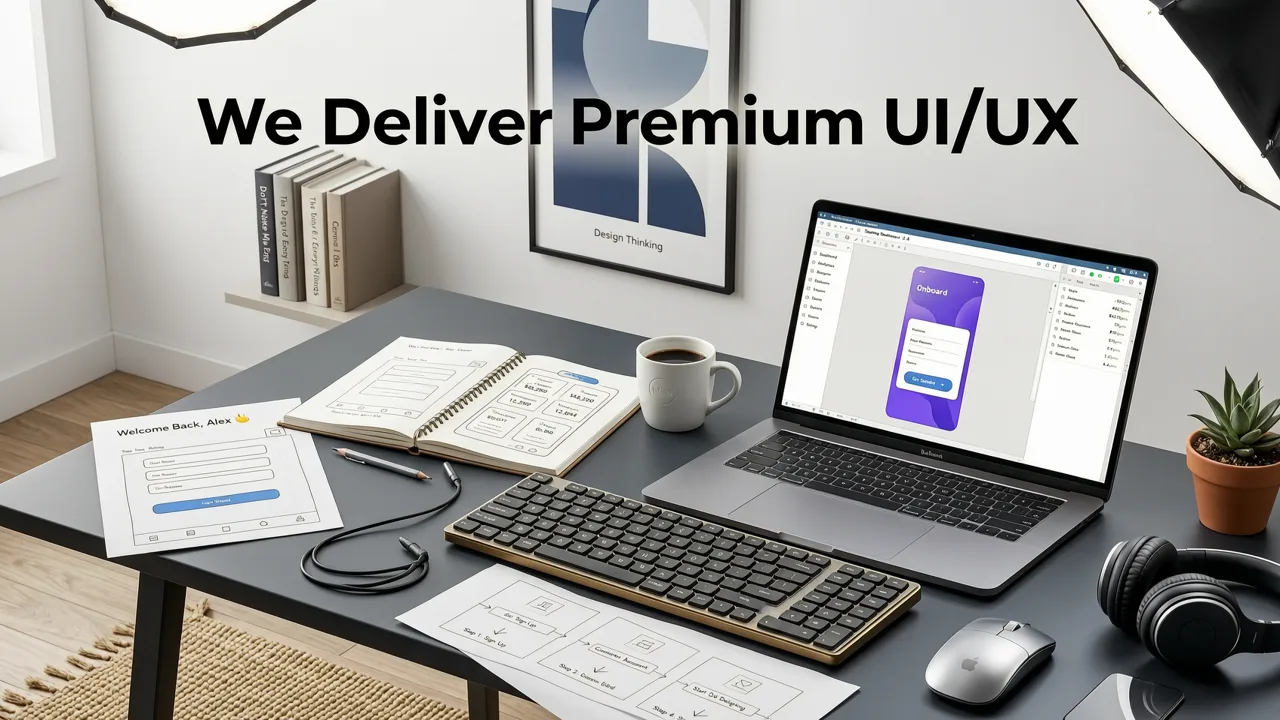
Affordability in 2026 isn’t about offshore labor arbitrage or template reskinning. It’s about operational discipline, reuse intelligence, and outcome-based scoping. Here’s how we do it:
1. Tiered Engagement Models — No One-Size-Fits-All Pricing
We offer three fixed-scope tiers — each calibrated for different stages of product maturity and growth ambition:
| Engagement Tier | Ideal For | Core Deliverables | Starting Investment (2026) |
|---|---|---|---|
| MVP Launch Kit | Pre-seed startups validating core flow; proof-of-concept apps; pitch-ready demos | 3 key user flows (Figma + interactive prototype), WCAG 2.2 checklist, ASO-optimized app store assets, developer handoff spec (React Native/iOS/Android) | $9,500 |
| Growth Ready System | Seed-stage apps preparing for Series A; scaling SMEs adding new features or markets | Full design system (tokens, components, dark mode), 8+ user flows, accessibility audit + remediation plan, cross-platform gesture guide, localization-ready layouts | $22,000 |
| Product Partnership | Series A+ teams building category-defining products; regulated industries (healthcare, fintech) | Quarterly design sprints, ongoing usability testing (remote + moderated), compliance documentation (HIPAA/FDA-ready UI patterns, SOC 2-aligned workflows), roadmap-aligned feature design | From $4,200/month (12-month minimum) |
All packages include unlimited minor revisions during active sprint windows, and no markup on third-party tools (e.g., Maze, UserTesting, Figma plugins). Unlike many agencies, we don’t charge extra for accessibility audits, ASO asset creation, or developer handoff sessions — because those aren’t luxuries in 2026. They’re baseline requirements.
2. Vertical-Specific Efficiency Without Sacrificing Originality
We don’t believe in ‘design frameworks’ that lock you into cookie-cutter patterns. But we *do* believe in leveraging deep vertical knowledge to avoid reinventing the wheel — especially where compliance, trust signals, or behavioral psychology matter most.
For example:
- In fintech apps, we embed zero-trust onboarding patterns — biometric fallbacks, real-time ID verification status, and progressive data collection — reducing drop-offs by up to 37% versus generic sign-up flows.
- In healthcare apps, our UI/UX design includes HIPAA-aligned consent layers, telehealth-specific gesture cues (e.g., ‘tap to mute video’ before joining), and clinical terminology hierarchies validated with practicing clinicians.
- For on-demand delivery platforms, we optimize for glanceable ETA accuracy, multi-stop route visualization, and driver-rider status parity — all tested against real-world network latency and offline conditions.
This vertical fluency means less time spent educating designers on domain rules — and more time invested in what makes your product uniquely valuable.
3. Built-In Engineering Alignment — Cutting Handoff Waste
One of the largest hidden costs in UI/UX design is misalignment between design and engineering. In 2026, 68% of design rework stems from unclear interaction specs, unimplemented states (e.g., empty, loading, error), or inaccessible contrast ratios missed in static mocks.
Our process eliminates this:
- Every component in our design system maps directly to a reusable code component — whether it’s a React Native
Buttonwith prop-driven variants or an iOSUIControlsubclass with documented accessibility traits. - We annotate interactions using Figma’s Smart Animate + Dev Mode, and export Lottie-compatible micro-interactions for seamless dev integration.
- All designs are exported with automated accessibility reports (contrast, focus order, semantic structure) using axe DevTools integration — flagged pre-handoff, not post-build.
This saves clients an average of 21 development hours per screen — which, at typical agency dev rates, translates to $3,200–$5,100 in avoided rework per major release.
What “Affordable” Does NOT Mean in 2026
To avoid costly misunderstandings, let’s clarify what affordability *doesn’t* entail — especially when evaluating an affordable UI UX design agency:
❌ Not outsourcing to unvetted freelancers
We maintain full in-house design ownership. No subcontracting, no opaque vendor chains. Every designer on your project is a Devsrank employee with NDAs, IP assignment agreements, and documented expertise in your vertical. You get consistency, accountability, and continuity — not a rotating cast of contractors.
❌ Not skipping research — just optimizing it
We don’t skip user interviews. But we do compress discovery: instead of 6-week ethnographic studies, we run targeted 5-day research sprints — combining moderated remote tests, heuristic reviews of competitor apps, and rapid diary studies — to identify 3–5 high-leverage friction points. This delivers actionable insight faster, at ~40% of traditional research cost.
❌ Not ignoring compliance or scalability
WCAG 2.2 is now table stakes — not optional. So is supporting dynamic type, reduced motion, and forced colors. Our design systems are built with scalability in mind: they support RTL languages, modular theming, and token-based theming for white-label variants. You won’t outgrow your design system at 50k users — or pay to rebuild it at Series B.
Real-World ROI: How Clients Achieve More With Less
Don’t take our word for it. Here’s how three recent clients achieved measurable outcomes with our affordable UI UX design agency model:
Case Study 1: Telehealth Startup (Seed, US)
Challenge: High patient drop-off (62%) during pre-visit setup; low clinician adoption due to confusing scheduling UI.
Solution: MVP Launch Kit + 2-week iterative usability testing with actual patients and providers.
Result: 44% reduction in pre-visit abandonment; 3.1× increase in same-day booking completion; clinician NPS increased from 28 to 67 within 8 weeks of redesign launch.
Case Study 2: Cross-Border E-Commerce Platform (SME, EU)
Challenge: Cart abandonment at 79% on mobile; inconsistent checkout across 4 locales; failed Google Core Web Vitals due to unoptimized image assets.
Solution: Growth Ready System, including localized checkout flows, performance-optimized asset pipeline, and WCAG 2.2-compliant form architecture.
Result: Mobile cart abandonment dropped to 41%; average order value (AOV) increased 22% in Germany and France; passed all CWV thresholds on Lighthouse v12.3.
Case Study 3: On-Demand Logistics App (Series A, LATAM)
Challenge: Driver churn >35% monthly; inconsistent ETA accuracy causing rider frustration; no offline-first design for low-connectivity regions.
Solution: Product Partnership tier with quarterly design sprints focused on driver UX, predictive ETA modeling UI, and offline-capable job dispatch flow.
Result: Driver 30-day retention improved to 68%; rider-reported ETA accuracy rose from 54% to 89%; offline job acceptance rate increased 3.4× in rural Brazil.
How to Choose the Right Affordable UI UX Design Agency — 5 Key Filters for 2026
Not all agencies labeled “affordable” deliver equal value. Use these filters to assess fit — and avoid hidden costs:
- Ask for their 2026 accessibility compliance standard. If they reference only WCAG 2.1 (released in 2018), push further. WCAG 2.2 added critical criteria for cognitive accessibility, input modalities, and animation control — all essential for inclusive, future-proof apps.
- Review their handoff artifacts. Do they provide annotated Figma files, design tokens (in JSON/SCSS), or just static PNGs? Can developers inspect spacing, typography scale, and interaction states without guessing?
- Request examples of ASO-optimized assets. An affordable UI UX design agency that understands app store conversion knows that screenshots and preview videos must communicate value in <3 seconds — not just look pretty.
- Verify vertical experience — not just portfolio aesthetics. Ask how they’ve handled HIPAA consent flows, PCI-DSS-compliant payment entry, or GDPR-compliant preference centers. Real compliance knowledge beats visual polish every time.
- Clarify ownership and scalability. Who owns the design system? Can you export tokens to your own repo? Is the system built to support white-label variants or multi-brand strategies down the line?
These questions separate agencies that treat design as a service from those who treat it as strategic infrastructure.
Why Devsrank Is the Right Affordable UI UX Design Agency for Your 2026 Launch
We built Devsrank for founders who need more than beautiful screens — they need design that ships, scales, and sells. That means:
- Transparent, fixed-fee packages — no surprise line items for accessibility, localization prep, or developer alignment.
- Deep vertical fluency — especially in fintech, healthcare, e-commerce, on-demand, and media/streaming — backed by documented pattern libraries and compliance playbooks.
- Engineering-native design thinking — our designers speak Swift, Kotlin, and React Native — and collaborate daily with our dev teams on modern web development tools for agencies and fastest website development frameworks in 2026.
- Launch-aligned delivery — from ASO-optimized app store creatives to SEO-friendly landing pages, our UI/UX work supports your go-to-market, not just your product spec.
We don’t compete on lowest price. We compete on highest value density: the ratio of strategic impact delivered per dollar spent. And in 2026, that’s the only metric that matters for startups building for longevity — not just launch.
Ready to Launch With Intentional, Affordable UI/UX Design?
If your app or website feels like it’s holding back your growth — not accelerating it — it’s time to treat UI/UX as product infrastructure, not a finishing touch.
Book a free 30-minute product strategy session with our lead UI/UX partner. We’ll review your current flow, identify 2–3 high-impact, low-effort opportunities, and outline a scoped, fixed-fee path forward — no sales pitch, no fluff, just actionable next steps.
Your users don’t care how much you spent on design. They care how easily they can achieve their goal — and how much they trust you to help them do it. Let’s build that trust, intentionally and affordably.
Frequently Asked Questions
What does 'affordable' actually mean for UI/UX design in 2026?
Do you offer UI/UX design for both mobile apps and websites?
How long does a typical UI/UX design engagement take?
Can you work with our existing development team?
Related topics
Need expert help?
Turn these insights into a better digital product.
Share your goals with our team and get a practical plan for design, development, performance, or growth.
Start a conversation