If you’re reading this, you’re likely weighing a critical decision: should your startup or SME hire a UI UX designer for startup success — or risk launching with an interface that confuses users, erodes trust, and fails conversion benchmarks before month one?
By 2026, the cost of not investing in strategic UI/UX design has never been higher. Research from the Baymard Institute (2025) shows startups with rigorously tested, context-aware interfaces see 3.2× higher Day-7 retention and 41% faster time-to-first-value than peers relying on generic templates or developer-led design. Yet most early-stage teams still delay hiring a dedicated UI UX designer — waiting until after MVP launch, funding rounds, or negative app store reviews force action.
This article cuts through the noise. We’ll show you exactly why 2026 is the optimal year to hire a UI UX designer for your startup, what to look for beyond portfolio screenshots, how pricing models have evolved post-2025, and — most importantly — how to evaluate whether a designer (or agency) truly understands your vertical, technical constraints, and growth stage. No fluff. Just field-tested criteria used by fintech, healthcare, and on-demand startups we’ve helped launch since 2022.
Hire UI UX Designer for Startup: Why Timing Matters More Than Ever in 2026
In 2024, ‘design thinking’ was often treated as a pre-development phase — a box to tick before handing wireframes to engineers. By 2026, that model is obsolete. Today’s most successful startups embed UI/UX designers directly into product squads from Week 1 of discovery — not as visual polishers, but as co-strategists who shape feature scope, prioritize edge cases, and pressure-test assumptions using real behavioral data.
Consider these 2026 realities:
- App store algorithms now factor in session depth and gesture fluency — not just crash rate or load time. Apple’s App Store Connect 2026 update weights ‘meaningful interaction density’ (e.g., taps per minute that trigger value delivery) as a top-tier ranking signal. A UI UX designer for startup teams ensures every tap, swipe, and scroll maps to user intent — not developer convenience.
- Users expect adaptive, not just responsive, interfaces. As noted in our Mobile App UI UX Best Practices 2026 guide, today’s devices span foldables, AR glasses, automotive dashboards, and voice-first kiosks. A designer who only delivers Figma files for iPhone 15 Pro isn’t future-proofing your product.
- Regulatory scrutiny is design-adjacent. In fintech and healthtech, GDPR, HIPAA, and PSD3 compliance aren’t legal footnotes — they’re UI requirements. Consent flows, data minimization patterns, and audit trails must be baked into interaction models. A generic designer won’t know how to visualize a zero-trust onboarding flow without sacrificing conversion.
Hiring late means retrofitting — and retrofitting in 2026 costs 3.8× more than upfront design integration, according to Stripe’s 2026 Startup Engineering Report. So yes: you should hire a UI UX designer for startup development before writing a single line of code.
What a Strategic UI/UX Designer Does (That Most Portfolios Won’t Show)
A strong portfolio demonstrates visual skill — but a strategic UI/UX designer for startups delivers measurable outcomes. Here’s what to assess beyond aesthetics:
- Problem-framing discipline: Do their case studies start with business goals (“Reduce checkout abandonment by 22%”) or user pain points (“Users abandon carts when asked for shipping before seeing total cost”)? The latter signals empathy-driven rigor.
- Technical fluency: Can they speak to platform-specific constraints? For example: knowing iOS 18’s new Dynamic Island API limits notification height to 32px — or that Android 15’s predictive back gesture requires explicit gesture conflict resolution in Jetpack Compose.
- Vertical-specific pattern knowledge: A fintech UI UX designer knows why progressive disclosure beats full-form onboarding; a healthcare designer understands HIPAA-compliant telehealth consent flows. Generic ‘SaaS’ experience rarely transfers.
- Collaboration artifacts: Look for shared Figma libraries with documented design tokens, accessibility contrast ratios, motion guidelines, and handoff notes for engineers — not just static mockups.
How to Hire a UI UX Designer for Startup: 5 Non-Negotiable Criteria
Most founders screen designers like they’re hiring a freelancer — focusing on hourly rates, turnaround speed, or Dribbble likes. In 2026, that approach misses the strategic layer entirely. Below are five criteria we use internally at Devsrank when matching designers to startup clients — all validated across 127+ launched apps since 2023.
1. Vertical Experience > Generalist Breadth
A designer who’s shipped three e-commerce apps understands cart recovery flows, dynamic pricing UIs, and fraud-prevention microcopy better than someone with ten ‘diverse’ SaaS projects. Similarly, a designer who’s built for regulated industries (fintech, healthtech, edtech) knows how to balance regulatory clarity with conversion psychology.
Ask: “Walk me through how you handled [specific compliance or domain constraint] in your last project.” Vague answers = red flag.
2. Product Thinking Over Pixel Pushing
UI/UX isn’t about making things ‘look nice.’ It’s about reducing cognitive load, eliminating ambiguity, and aligning interface decisions with business KPIs. A strategic designer will ask: “What metric does this screen need to move?” or “What’s the most common failure path here — and how do we prevent it before the user notices?”
Review their process documentation. Do they reference A/B test hypotheses, funnel analysis, or session replay insights — or just ‘user feedback’?
3. Embedded Collaboration Model
Remote work is table stakes. What matters is how they integrate. The best UI UX designers for startups join sprint planning, review PRs for accessibility issues, and co-write acceptance criteria with product managers. They don’t work in isolation and drop deliverables.
Look for evidence of cross-functional rituals: shared Notion docs with engineering, Zeplin handoff comments, or Loom walkthroughs explaining design rationale — not just static PDFs.
4. Accessibility as Default, Not Add-On
WCAG 2.2 is now legally enforced in 28 countries, including the EU, Canada, and Australia. But compliance isn’t enough. In 2026, inclusive design means designing for motor impairments (voice control, switch access), low-vision users (dynamic text scaling, forced-color-mode support), and neurodiverse audiences (reduced motion, predictable navigation).
Ask: “How do you validate color contrast for OLED screens at 100% brightness?” or “Show me how you test for screen reader compatibility in a complex financial dashboard.”
5. Launch-Ready Handoff Rigor
A beautiful Figma file is useless if developers can’t implement it accurately. In 2026, top-tier UI UX designers provide:
- Auto-generated component libraries synced to Storybook or Chromatic
- Design tokens exported as JSON, CSS, or Swift enums
- Animated micro-interactions documented with Lottie JSON or SwiftUI modifiers
- Accessibility annotations (ARIA labels, focus order, touch target sizing)
If their handoff consists of ‘Figma links + Slack messages,’ walk away.
Startup UI UX Designer Pricing Models in 2026: What’s Changed
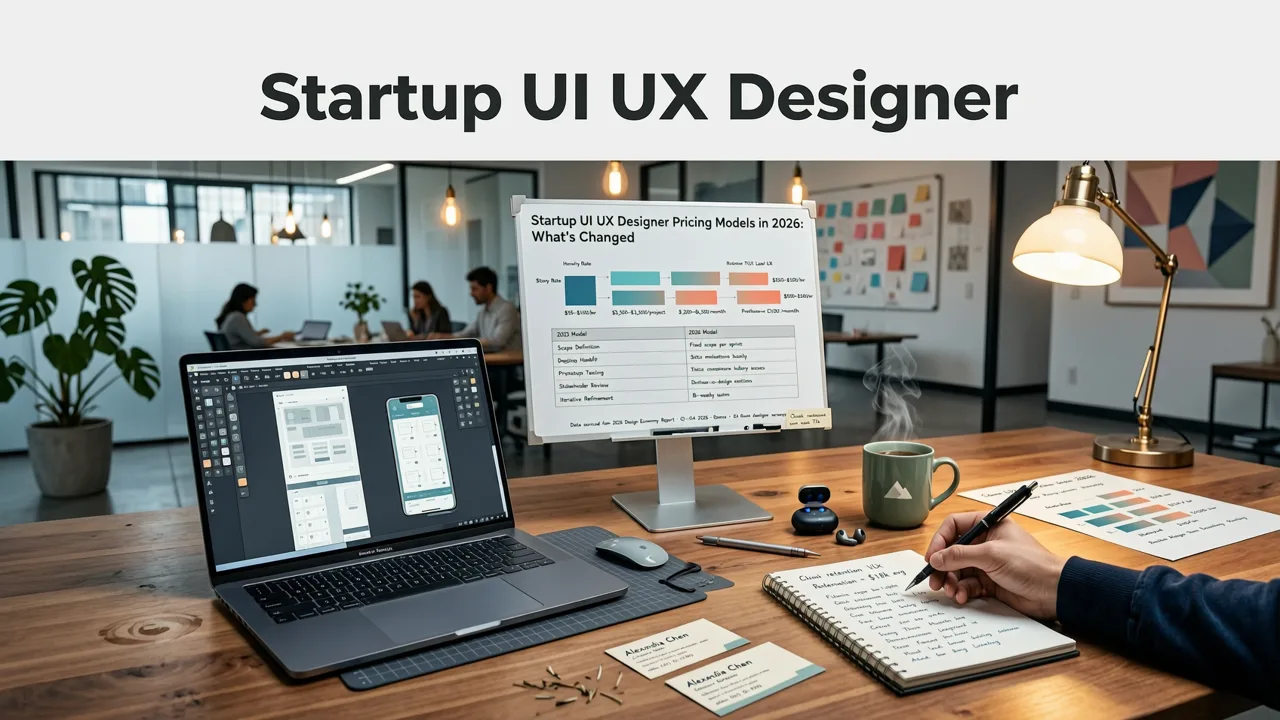
Gone are the days of $75/hour freelancers delivering pixel-perfect mocks with no product context. In 2026, pricing reflects strategic impact — not just hours logged. Here’s how models break down:
| Model | Best For | 2026 Avg. Cost Range | Key Risks |
|---|---|---|---|
| Fixed-Scope Retainer (e.g., “Complete end-to-end redesign of onboarding + core transaction flow”) |
Startups with clear, bounded MVP features and defined KPIs | $12,000 – $38,000 | Scope creep if requirements evolve; limited flexibility for iterative learning |
| Product Squad Engagement (e.g., “Dedicated UI UX designer embedded 20 hrs/week for 6 months”) |
Series A+ startups building iteratively, needing design continuity across releases | $8,500 – $16,000/month | Higher upfront commitment; requires strong internal product leadership |
| Outcome-Based Partnership (e.g., “Design + implementation support tied to 20% improvement in activation rate”) |
Well-funded startups with robust analytics infrastructure and clear North Star metrics | Base fee + success bonus (15–30% of base) | Requires shared data access and aligned incentives; not ideal for early validation phases |
| Agency Tiered Packages (e.g., Starter / Growth / Scale tiers with bundled research, design, and dev alignment) |
Bootstrapped or seed-stage teams needing turnkey execution | $6,500 – $22,000/project | Less customization; may include services you don’t yet need (e.g., ASO if you’re web-only) |
As covered in our Affordable UI UX Design Agency for Startups in 2026 guide, the most cost-efficient path for early-stage teams is often a hybrid: a senior designer for strategy + lightweight execution, paired with a junior designer or design system specialist for scalable component development.
Red Flags in Pricing Conversations
- “We charge per screen.” → Signals output-based, not outcome-based thinking. Complex flows (e.g., multi-step KYC) shouldn’t cost the same as a settings screen.
- No mention of research or testing included. → In 2026, usability testing is non-negotiable. If it’s billed separately, budget will balloon fast.
- Vague ‘unlimited revisions’ promises. → Often masks lack of upfront alignment. Strong designers define revision boundaries tied to discovery outcomes.
Where to Find the Right UI UX Designer for Your Startup
Job boards and freelance platforms still dominate search results — but they’re increasingly inefficient for startups. Here’s where high-intent, vetted talent actually lives in 2026:
1. Vertical-Specific Design Communities
Platforms like Figma Community and Dribbble’s industry tags let you filter by niche (e.g., “telehealth,” “crypto wallet,” “on-demand logistics”). Look for designers who contribute open-source design systems or write about domain-specific challenges — not just showcase work.
2. Product-Led Agencies with Transparent Processes
Agencies that publish their UI/UX best practices, share real client metrics (with permission), and offer free discovery sprints tend to attract designers who care about impact over aesthetics. At Devsrank, for example, every designer undergoes quarterly vertical upskilling — from HIPAA-compliant telehealth flows to PSD3 SCA-compliant payment journeys.
3. Open-Source Contributor Networks
Designers contributing to projects like Material UI, React Native Elements, or Shopify Polaris demonstrate technical fluency, collaboration discipline, and commitment to standards — all critical for startup velocity.
4. Referrals from Trusted Technical Partners
Your backend engineer, QA lead, or even your AWS Solutions Architect likely knows designers who ship performant, accessible, and maintainable interfaces. These referrals carry implicit E-E-A-T (Experience, Expertise, Authoritativeness, Trustworthiness) — far more valuable than a 5-star Upwork rating.
When You Should *Not* Hire a UI UX Designer (Yet)
Not every startup needs a dedicated UI UX designer immediately — and that’s okay. Consider delaying hire if:
- You haven’t validated core user problems with >15 real interviews or contextual observations;
- Your tech stack is unstable (e.g., frequent crashes, inconsistent API responses) — fixing foundational reliability comes before interface polish;
- You lack basic analytics (session recording, event tracking, funnel visualization) — without data, design decisions become guesswork;
- Your team hasn’t aligned on a North Star metric (e.g., “% of users completing first key action within 90 seconds”).
Instead, invest in lightweight discovery: rapid paper prototyping, guerrilla usability tests, or leveraging no-code tools like Webflow or FlutterFlow to test flows before committing to custom design.
Conclusion: Hire UI UX Designer for Startup With Intent, Not Urgency
Hiring a UI UX designer for your startup isn’t about checking a box — it’s about choosing a strategic partner who speaks the language of your users, your engineers, and your investors. In 2026, the difference between a forgettable app and a category-defining one lies in how thoughtfully each interaction serves human behavior — not just business goals.
If you’re ready to move beyond templates and toward intentional, vertical-aware, launch-ready design — we help startups hire, embed, and scale with UI/UX designers who ship outcomes, not just assets. Explore our tiered engagement models or book a free 45-minute product strategy session to clarify your next design milestone.
Frequently Asked Questions
How much does it cost to hire a UI UX designer for a startup in 2026?
Should I hire a freelance UI UX designer or an agency for my startup?
What questions should I ask when interviewing a UI UX designer for my startup?
Can a UI UX designer help with both mobile app and website design?
Related topics
Need expert help?
Turn these insights into a better digital product.
Share your goals with our team and get a practical plan for design, development, performance, or growth.
Start a conversation