
Cross-Platform App Development Cost 2026: The Real Numbers
If you are budgeting a mobile product in 2026, the single question you will hear from every stakeholder is this: how much does a cross-platform app actually cost? Founders, product managers, and CTOs all need a defensible number before writing a single line of code. The short answer is that cross-platform app development cost in 2026 ranges from $25,000 for a lean MVP to $250,000+ for a feature-rich, regulated product. The long answer depends on framework choice, team geography, app complexity, and the post-launch roadmap you plan around.
This guide breaks down every cost layer so you can build a realistic budget, compare vendor quotes with confidence, and avoid the surprise expenses that derail most mobile projects halfway through development.
Why Cross-Platform App Development Cost Still Matters in 2026
Cross-platform frameworks like Flutter, React Native, and Kotlin Multiplatform have matured significantly. In 2026, they power production apps for fintech, healthcare, e-commerce, and on-demand delivery companies worldwide. Yet the cost conversation has not disappeared, it has shifted.
Instead of asking whether cross-platform is cheaper than native, the smarter question is: where should I invest my budget to maximize user retention, performance, and time-to-market? A well-scoped cross-platform app can still save 30–40% compared to building two separate native apps, but only if you plan the architecture correctly from day one.
What has changed in 2026
- Flutter 4 and React Native 0.80+ have narrowed the performance gap with native, reducing the need for platform-specific rewrites.
- AI-assisted coding tools have accelerated boilerplate development, lowering early-stage engineering hours.
- App store compliance requirements, especially in healthcare and fintech, have increased QA and documentation overhead.
- Cloud infrastructure costs for real-time features, push notifications, and analytics remain a meaningful line item.
Average Cross-Platform App Development Cost Ranges in 2026
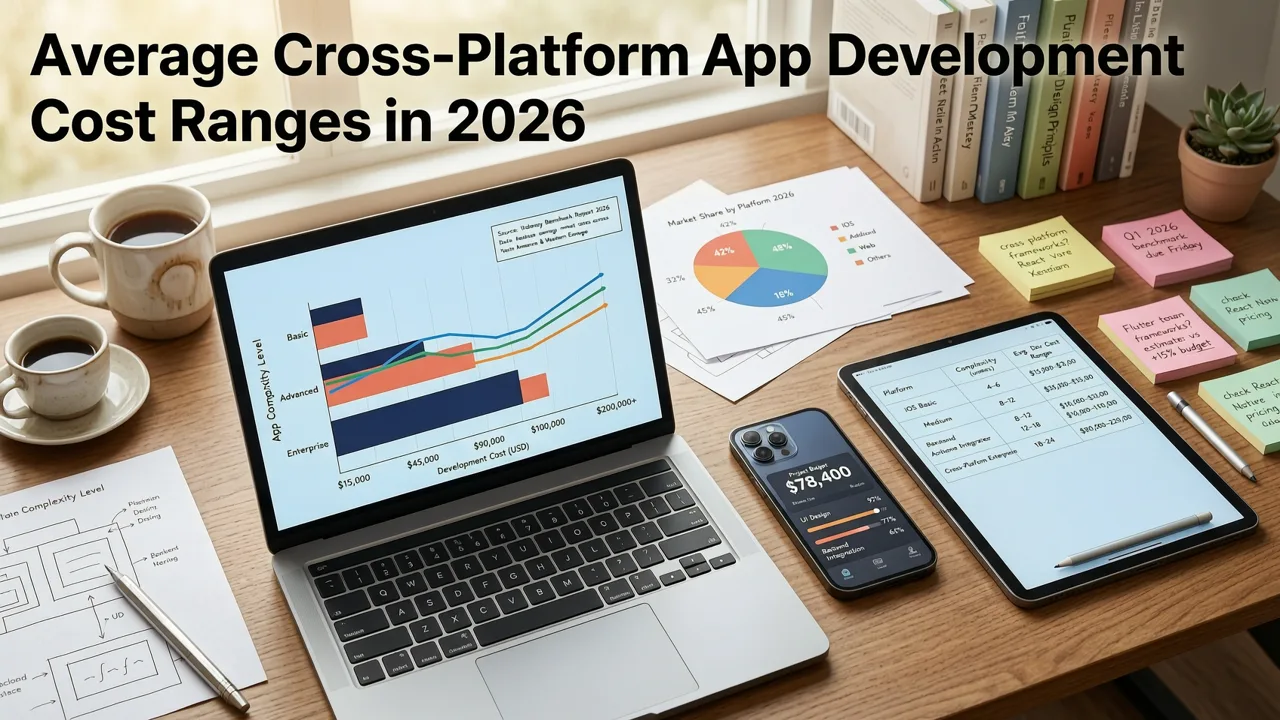
Below is a practical pricing table based on current market data across agency partners in North America, Eastern Europe, and South Asia. These ranges reflect full-cycle development: discovery, design, engineering, QA, and launch support.
| App Complexity | Typical Features | Timeline | Cost Range (USD) |
|---|---|---|---|
| Simple MVP | User auth, 3–5 screens, basic API integration, push notifications | 6–10 weeks | $25,000 – $50,000 |
| Medium Complexity | Payment gateway, real-time chat, admin panel, third-party integrations | 3–5 months | $50,000 – $120,000 |
| High Complexity | Multi-role marketplace, geolocation, streaming, custom animations, HIPAA or PCI scope | 5–9 months | $120,000 – $250,000+ |
| Enterprise / Regulated | Healthcare, fintech, or compliance-heavy apps with audit trails and encryption | 9–14 months | $200,000 – $500,000+ |
These figures assume a single cross-platform codebase deployed to both iOS and Android. If you later need a native companion app for a specific platform, budget an additional 40–60% of the original development cost.
Key Factors That Influence Cross-Platform App Development Cost
1. Framework Choice: Flutter vs React Native vs Kotlin Multiplatform
Your framework decision shapes both upfront cost and long-term maintenance. In 2026:
- Flutter remains the fastest path to a polished UI with custom design systems. It is ideal for startups that want pixel-perfect branding across both platforms.
- React Native is the strongest choice when your team already has JavaScript expertise or when you want to share logic with a web application.
- Kotlin Multiplatform is gaining ground for teams that want to share business logic while keeping native UI layers. It tends to cost slightly more upfront but reduces platform-specific bugs over time.
2. Team Location and Engagement Model
Hourly rates continue to vary dramatically by region. A senior cross-platform engineer in North America typically bills $120–$200 per hour, while a similarly skilled engineer in Eastern Europe bills $50–$90, and one in South Asia bills $30–$60. The right engagement model, whether a dedicated team, staff augmentation, or fixed-scope project, also affects total cost.
If you are evaluating partners, this practical guide to choosing a mobile app developer walks through the questions that separate reliable agencies from risky ones.
3. Design and UX Investment
Cross-platform does not mean design shortcuts. Users in 2026 expect fluid animations, accessibility compliance, and platform-aware navigation patterns. Budget $8,000–$30,000 for UX research, wireframes, and a complete design system depending on screen count and interaction complexity.
4. Backend and API Development
Most cross-platform apps rely on a cloud backend for authentication, data storage, and business logic. If you do not already have an API, expect to add $15,000–$80,000 for backend development, depending on data model complexity and third-party integrations.
5. Compliance and Security Requirements
Regulated industries carry higher development costs because every feature must be documented, tested, and auditable. A HIPAA-compliant healthcare app will cost significantly more than a consumer media app due to encryption, access controls, and audit logging requirements. Similarly, fintech apps must meet PCI-DSS and regional financial regulations, adding 20–35% to the overall budget.
Hidden Costs Most Founders Overlook
The development invoice is only part of the picture. Smart budgeting accounts for these ongoing and often surprise expenses:
- App store developer accounts: $99/year for Apple, $25 one-time for Google.
- Third-party SDKs and APIs: Mapping, messaging, analytics, and payment providers often charge per active user or per transaction.
- Cloud hosting and infrastructure: AWS, GCP, or Azure bills scale with traffic. Budget $500–$5,000+ per month post-launch.
- QA and device testing: Cross-platform apps still require testing across device sizes, OS versions, and network conditions.
- App Store Optimization (ASO): A strong launch needs keyword research, screenshot design, and iterative metadata testing.
- Maintenance and updates: Plan for 15–20% of the original development cost annually to keep the app compatible with new OS releases and security patches.
Cross-Platform vs Native: Cost Comparison in 2026
Here is a side-by-side look at what founders typically spend when choosing cross-platform versus building two native apps from scratch.
| Cost Category | Cross-Platform (Single Codebase) | Native iOS + Android |
|---|---|---|
| Development effort | 1x | 1.7x – 2x |
| Design system | Shared | Separate per platform |
| QA cycles | Fewer, but still dual-platform | Full per platform |
| Time to market | 30–40% faster | Slower |
| Long-term maintenance | Lower if architecture is clean | Higher due to two codebases |
For startups validating a product idea, cross-platform is almost always the smarter financial decision. For apps that demand cutting-edge platform features, such as advanced AR, deep system integrations, or high-performance gaming, a native approach may still be justified.
How to Reduce Cross-Platform App Development Cost Without Sacrificing Quality
Start with a focused MVP
Ship the smallest feature set that proves your core hypothesis. A disciplined MVP keeps you in the $25,000–$50,000 range and generates real user data before you commit to a larger build.
Reuse and modularize
Invest in a component library early. Reusable UI modules, shared state management, and standardized API contracts reduce rework across sprints and make future feature additions cheaper.
Leverage AI development tools
In 2026, AI-assisted code generation, automated test writing, and design-to-code pipelines can reduce repetitive engineering hours by 20–30%. Make sure your agency partner uses these tools responsibly and reviews all AI-generated output.
Choose the right engagement model
Fixed-price contracts work well for clearly scoped MVPs. Time-and-materials or dedicated team models are better for evolving products where requirements change based on user feedback.
What a Realistic 2026 Budget Looks Like
For a typical Series A startup launching a medium-complexity cross-platform app in a competitive category like e-commerce or on-demand delivery, here is a realistic budget snapshot:
- Discovery and product strategy: $5,000 – $15,000
- UX/UI design: $10,000 – $25,000
- Cross-platform development: $50,000 – $100,000
- Backend and API: $20,000 – $50,000
- QA and testing: $8,000 – $18,000
- Launch, ASO, and initial marketing: $5,000 – $15,000
- Total estimated range: $98,000 – $223,000
This range assumes a mid-tier agency engagement with a mixed onshore-offshore team. If you are an early-stage startup focused on iOS-first validation, you may find the iOS app development guide for startups more relevant to your current phase.
Choosing the Right Development Partner
Cost is only one dimension of the vendor decision. The agency you choose will influence your timeline, product quality, and ability to scale. Look for partners who provide transparent pricing, a clear discovery process, and post-launch support. A detailed pricing guide like this complete cross-platform app development cost breakdown can help you benchmark quotes and ask the right questions during vendor evaluation.
Questions to ask every agency
- Can you provide a detailed cost breakdown by phase, not just a single lump sum?
- Which cross-platform framework do you recommend for my use case and why?
- How do you handle scope changes and unexpected technical challenges?
- What does your post-launch support and maintenance offering include?
- Can you share case studies in my industry, such as fintech, healthcare, or e-commerce?
Final Thoughts on Cross-Platform App Development Cost in 2026
The cost of building a cross-platform app in 2026 is more transparent than ever, but it still requires careful planning. Framework maturity, AI tooling, and global talent pools have created real opportunities to launch high-quality products at efficient price points. The founders who succeed are the ones who treat budgeting as a strategic exercise, not a guessing game.
Whether you are validating a new idea or scaling an existing product, the right partner and the right scope will determine whether your investment delivers returns. Start with a clear product strategy, build a focused MVP, and plan for the ongoing costs that keep your app competitive long after launch day.
Ready to build your cross-platform app with a team that understands startup economics? Explore the complete pricing guide and schedule a discovery call to get a tailored estimate for your product.
Frequently Asked Questions
How much does cross-platform app development cost in 2026?
Is cross-platform app development cheaper than native development?
Which cross-platform framework is most cost-effective in 2026?
What hidden costs should I budget for after launching a cross-platform app?
How can startups reduce cross-platform app development costs?
Related topics
Need expert help?
Turn these insights into a better digital product.
Share your goals with our team and get a practical plan for design, development, performance, or growth.
Start a conversation