
Cross-Platform App Development Cost in 2026: The Real Numbers
If you are budgeting a mobile product in 2026, the single question you will hear from every stakeholder is this: how much does a cross-platform app actually cost to build? The short answer is that most startups and growing businesses spend between $40,000 and $180,000 for a production-ready cross-platform application in 2026, depending on complexity, team location, and scope. The longer answer requires understanding what drives that price, where budgets quietly leak, and how to choose a framework and partner that keeps your product on track.
This guide breaks down cross-platform app development cost line by line, compares the leading frameworks, and gives you a practical framework for estimating your own project before you sign a single contract.
Why Cross-Platform App Development Cost Still Matters in 2026
Cross-platform frameworks like Flutter, React Native, and .NET MAUI have matured considerably. In 2026, they power everything from fintech wallets to healthcare portals to on-demand delivery platforms. The promise remains the same: one codebase, two (or more) platforms, lower total cost of ownership.
But "lower cost" does not mean "cheap." Founders who compare a cross-platform quote to a template builder price tag are setting themselves up for disappointment. What cross-platform development actually delivers is efficiency — a smaller team, a shorter timeline, and a single codebase that is easier to maintain — which translates into meaningful savings compared to building native iOS and Android apps in parallel.
Understanding the real cost structure helps you:
- Set realistic expectations with investors or stakeholders
- Choose the right framework for your product category
- Avoid scope creep and surprise invoices mid-project
- Decide whether to hire an in-house team, a freelance developer, or a dedicated agency
Average Cross-Platform App Development Cost Ranges in 2026
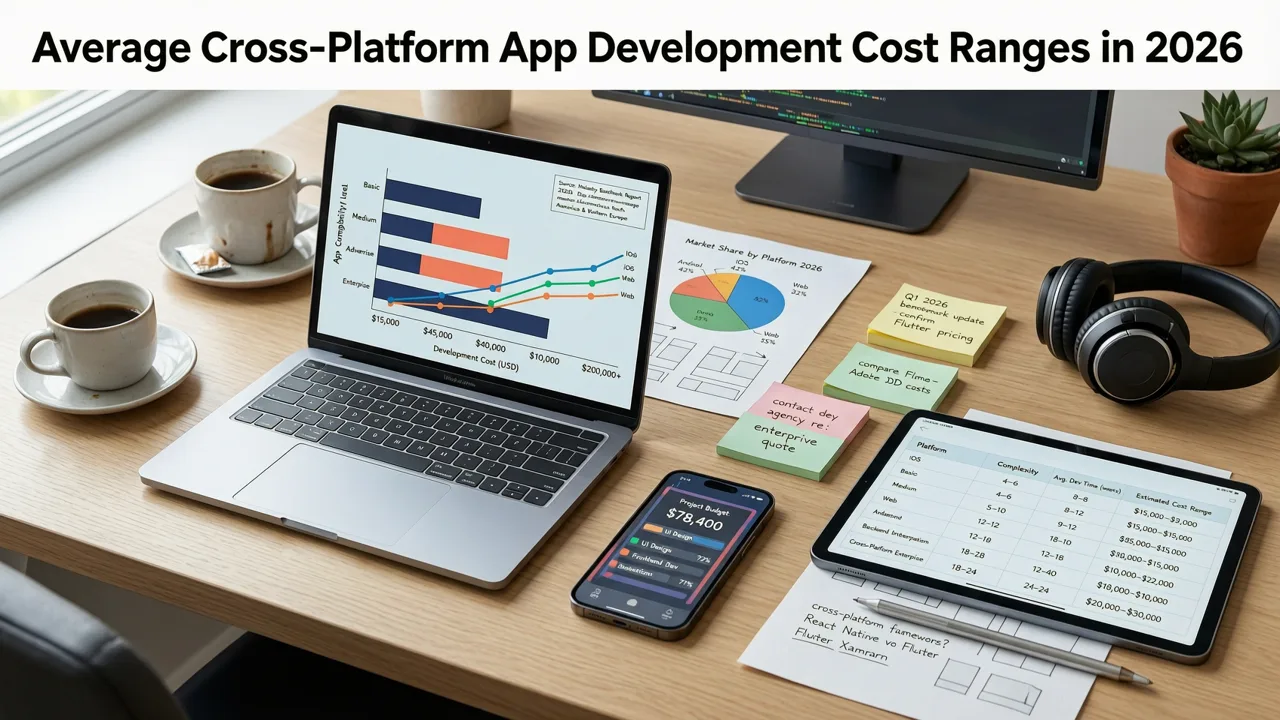
Based on market data and agency pricing models in 2026, here is a realistic cost breakdown by project complexity:
| App Complexity | Estimated Cost (USD) | Timeline | Typical Features |
|---|---|---|---|
| Simple App | $40,000 – $60,000 | 3 – 4 months | User auth, basic CRUD, push notifications, 5–10 screens |
| Medium Complexity | $60,000 – $120,000 | 4 – 7 months | Payment integration, API connections, admin panel, 15–30 screens |
| Complex App | $120,000 – $180,000+ | 7 – 12+ months | Real-time features, AI/ML, third-party SDKs, compliance layers, 30+ screens |
| Enterprise-Grade | $200,000 – $500,000+ | 10 – 18+ months | Multi-tenant architecture, advanced security, regulatory compliance, custom integrations |
These figures assume you are working with a professional development agency. Freelancers and offshore teams may quote lower rates, but the total cost of ownership — including rework, delays, and technical debt — often narrows the gap significantly.
Key Factors That Influence Cross-Platform App Development Cost
1. App Complexity and Feature Set
This is the single biggest cost driver. A straightforward content app with a login screen and a feed will cost a fraction of a fintech application that requires PCI-DSS compliance, real-time transaction processing, and biometric authentication. Every additional feature — chat, geolocation, video streaming, in-app purchases, AI-powered recommendations — adds design, engineering, testing, and maintenance hours.
2. Framework Selection
The framework you choose affects both upfront development cost and long-term maintenance expense. Here is how the three leading options compare in 2026:
| Framework | Best For | Cost Impact | Developer Availability |
|---|---|---|---|
| Flutter | Custom UI, high-performance apps, startups targeting both platforms | Moderate — single codebase with near-native performance | High and growing |
| React Native | Apps with large existing web teams, content-heavy apps | Moderate — large ecosystem, but bridge overhead for complex animations | Very high |
| .NET MAUI | Enterprise apps, Microsoft-stack organizations | Higher — smaller talent pool, longer ramp-up | Moderate |
Flutter has gained significant ground in 2026, particularly for startups that need pixel-perfect UI and strong performance across iOS and Android from a single codebase. React Native remains a solid choice when your team already has deep JavaScript or TypeScript expertise. .NET MAUI is the right call for organizations invested in the Microsoft ecosystem.
3. Design and UX Requirements
UI/UX design typically accounts for 15% to 25% of total development cost. If your product demands a highly polished, brand-driven experience — which it should, if you want user retention — expect to invest in wireframing, prototyping, user testing, and design system creation. Industries like healthcare and fintech have additional usability and accessibility requirements that increase design effort. For more on this, see our guide on Healthcare App UI UX Design Principles for 2026.
4. Backend and Infrastructure
Your app is only as good as the server-side architecture supporting it. Backend development costs depend on whether you need a simple REST API or a complex microservices architecture with real-time data synchronization, third-party integrations, and scalability built in from day one. Cloud hosting, database design, and DevOps setup are separate line items that startups frequently underestimate.
5. Team Location and Engagement Model
Hourly rates vary dramatically by region in 2026:
- North America: $120 – $200 per hour
- Western Europe: $80 – $150 per hour
- Eastern Europe: $50 – $90 per hour
- South Asia: $30 – $60 per hour
- Latin America: $45 – $80 per hour
Lower hourly rates do not automatically mean lower total cost. Communication overhead, timezone differences, code quality, and project management maturity all affect the final invoice. Many startups find that a US-based mobile app development agency delivers better value per dollar when you factor in speed, accountability, and strategic input.
6. Third-Party Integrations
Payment gateways, mapping services, analytics platforms, push notification providers, identity verification services — each integration adds development time and ongoing subscription costs. A fintech app might require five to eight third-party services, while a simple content app might need only two or three.
7. Testing and Quality Assurance
QA typically represents 15% to 20% of the total project budget. Cross-platform apps require testing across multiple devices, OS versions, and screen sizes. Automated testing reduces long-term costs but requires upfront investment in test architecture.
Cross-Platform vs. Native: A Cost Comparison
The most common alternative to cross-platform development is building separate native apps for iOS and Android. Here is a simplified comparison:
| Factor | Cross-Platform | Native (iOS + Android) |
|---|---|---|
| Development Time | 30% – 40% faster | Longer — two separate codebases |
| Upfront Cost | Lower — single codebase | Higher — essentially two projects |
| Maintenance Cost | Lower — one codebase to update | Higher — changes must be duplicated |
| Performance | Near-native for most use cases | Best-in-class for graphics-heavy apps |
| Access to Device Features | Good, with some limitations | Full access to all native APIs |
| Time to Market | Faster | Slower |
For the majority of startups and SMEs in 2026, cross-platform development offers the best balance of cost, speed, and quality. Native development makes sense when your app is heavily graphics-dependent (games, AR/VR experiences) or when you need deep, platform-specific integrations that cross-platform frameworks cannot yet handle elegantly.
Hidden Costs That Catch Startups Off Guard
The quoted development price is never the full picture. Here are the costs that routinely surprise first-time founders:
App Store and Developer Account Fees
Apple charges $99 per year for a developer account. Google charges a one-time $25 fee. These are small numbers, but they are the first of many post-launch expenses.
Ongoing Maintenance and Updates
Plan for 15% to 20% of your initial development cost per year in ongoing maintenance. This covers OS compatibility updates, bug fixes, security patches, and minor feature enhancements. Skipping maintenance is how apps accumulate technical debt and eventually require expensive rewrites.
Server and Infrastructure Costs
Cloud hosting costs scale with your user base. A small app might run on $50 to $200 per month, but a growing product serving thousands of daily active users can easily reach $1,000 to $5,000+ per month in infrastructure costs.
Marketing, SEO, and ASO
Building a great app is only half the battle. Getting users to find it requires investment in app store optimization, search engine optimization for your web presence, and user acquisition campaigns. Many agencies, including Devsrank, bundle product strategy and launch support with development to ensure your app does not launch into silence.
Compliance and Legal
Depending on your industry, you may need to budget for GDPR compliance, HIPAA compliance (for healthcare apps), PCI-DSS certification (for fintech), or accessibility audits. These are not optional if you want to operate legally and build user trust.
How to Reduce Cross-Platform App Development Cost Without Sacrificing Quality
Start With a Discovery Sprint
A well-run discovery phase — typically two to four weeks — saves multiples of its cost downstream. You define your product scope, validate assumptions, prioritize features, and create a technical architecture before writing production code. This is the single highest-ROI investment you can make.
Prioritize an MVP
Do not try to build everything in version one. Identify the core features that deliver value to your target users and launch with those. You can iterate based on real feedback rather than guesswork, and you will reach the market months earlier.
Choose the Right Framework Early
Switching frameworks mid-project is enormously expensive. Invest time upfront in evaluating Flutter, React Native, and .NET MAUI against your specific product requirements, team capabilities, and long-term roadmap.
Use Pre-Built Components and Libraries
Both Flutter and React Native have rich ecosystems of pre-built UI components, authentication modules, and integration libraries. Leveraging these reduces custom development time without sacrificing quality.
Partner With an Experienced Agency
An agency that has shipped dozens of cross-platform apps brings pattern recognition that freelancers and in-house teams often lack. They know which architectural decisions will save money at scale and which shortcuts will cost you dearly six months from now. If you are in the fintech space, for example, working with a team that understands fintech app development regulations and compliance requirements from day one prevents costly rework later.
What a Typical Cross-Platform App Development Budget Looks Like
Here is a representative budget allocation for a medium-complexity cross-platform app ($90,000 total):
| Phase | Percentage of Budget | Estimated Cost |
|---|---|---|
| Discovery & Product Strategy | 10% | $9,000 |
| UI/UX Design | 20% | $18,000 |
| Frontend Development (Flutter/React Native) | 35% | $31,500 |
| Backend Development & APIs | 20% | $18,000 |
| QA & Testing | 10% | $9,000 |
| Deployment & Launch Support | 5% | $4,500 |
These percentages shift based on project specifics, but they provide a useful mental model for understanding where your money goes.
Frequently Asked Questions
Is cross-platform app development cheaper than native development?
Generally, yes. Cross-platform development typically costs 30% to 40% less than building separate native iOS and Android apps because you maintain a single codebase. However, the gap narrows for apps that require heavy use of platform-specific features or advanced graphics.
How long does it take to build a cross-platform app?
A simple cross-platform app takes three to four months. A medium-complexity app takes four to seven months. Complex applications with advanced features, third-party integrations, and compliance requirements can take seven to twelve months or more.
What is the best cross-platform framework in 2026?
There is no single "best" framework. Flutter is ideal for startups wanting high-performance custom UI. React Native works well when your team has strong JavaScript expertise. .NET MAUI suits organizations invested in the Microsoft ecosystem. The right choice depends on your product requirements, team skills, and long-term roadmap.
What are the ongoing costs after launching a cross-platform app?
Plan for 15% to 20% of your initial development cost annually for maintenance, plus server and infrastructure costs that scale with your user base. App store fees, third-party service subscriptions, and marketing budgets are additional ongoing expenses.
Can I start with a small budget and scale later?
Absolutely. An MVP approach lets you launch with core features at a lower cost, validate your product in the market, and then invest in additional features based on real user data and feedback. This is how most successful startups approach app development.
Final Thoughts on Cross-Platform App Development Cost in 2026
Cross-platform app development remains one of the smartest investments a startup or growing business can make in 2026. The frameworks are mature, the talent pool is deep, and the cost savings compared to native development are substantial. But "cost-effective" does not mean "cheap," and the difference between a successful product and an expensive failure often comes down to how well you plan, prioritize, and partner.
If you are ready to explore what a cross-platform app could look like for your business, the best next step is a focused discovery conversation with a team that has shipped real products in your category. That conversation will give you a realistic budget, a clear roadmap, and the confidence to move forward — or to pivot before you spend a dollar on development.
Contact Devsrank today to discuss your cross-platform app project and get a tailored cost estimate for your product.
Frequently Asked Questions
Is cross-platform app development cheaper than native development?
How long does it take to build a cross-platform app?
What is the best cross-platform framework in 2026?
What are the ongoing costs after launching a cross-platform app?
Can I start with a small budget and scale later?
Related topics
Need expert help?
Turn these insights into a better digital product.
Share your goals with our team and get a practical plan for design, development, performance, or growth.
Start a conversation