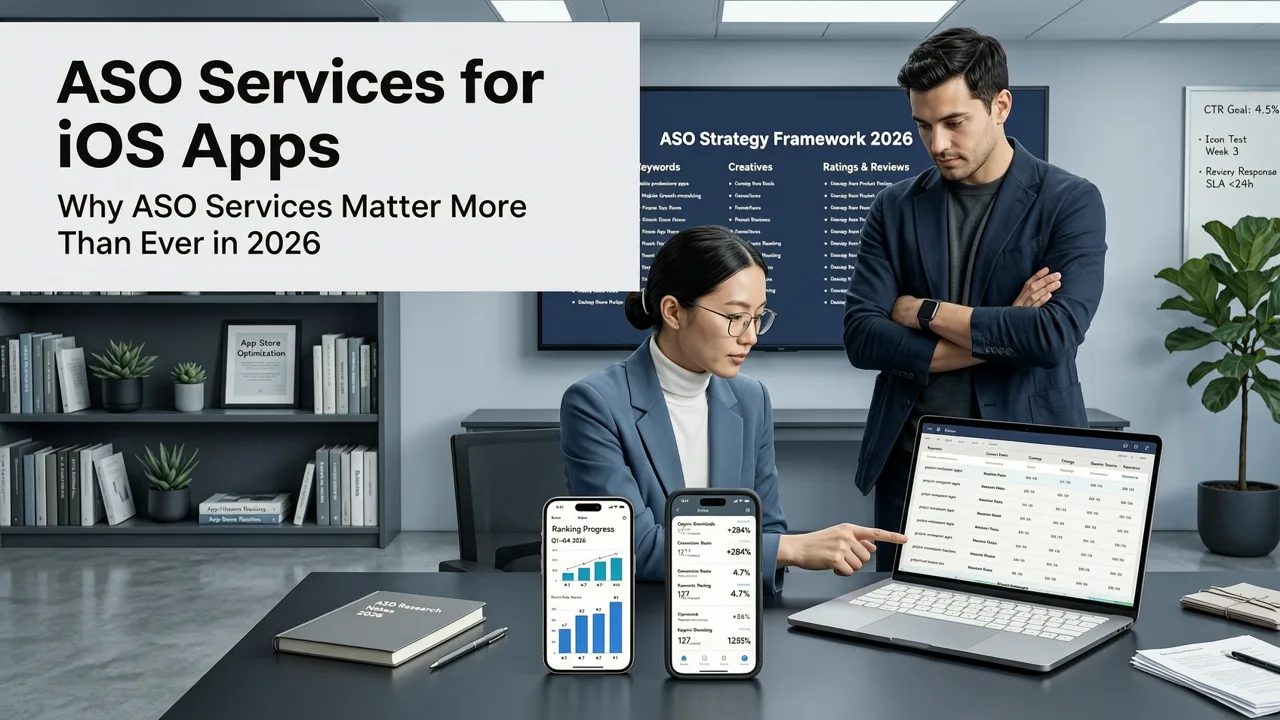
Why ASO Services for iOS Apps Matter More Than Ever in 2026
If your iOS app isn't ranking for the keywords your ideal users actually type, you are paying for installs you could be earning for free. App Store Optimization services for iOS apps help you capture that organic demand by aligning your metadata, creative assets, and conversion signals with how Apple's ranking algorithm evaluates relevance and quality in 2026.
The short answer: professional ASO services for iOS apps combine keyword research, creative testing, rating management, and conversion rate optimization to increase your App Store visibility, improve your tap-through rate, and grow sustainable organic downloads month over month.
In this guide, we break down exactly what modern ASO services for iOS apps include, how Apple's algorithm has evolved, what you should expect to pay, and how to choose a partner that delivers measurable results rather than vanity metrics.
What App Store Optimization for iOS Actually Covers in 2026
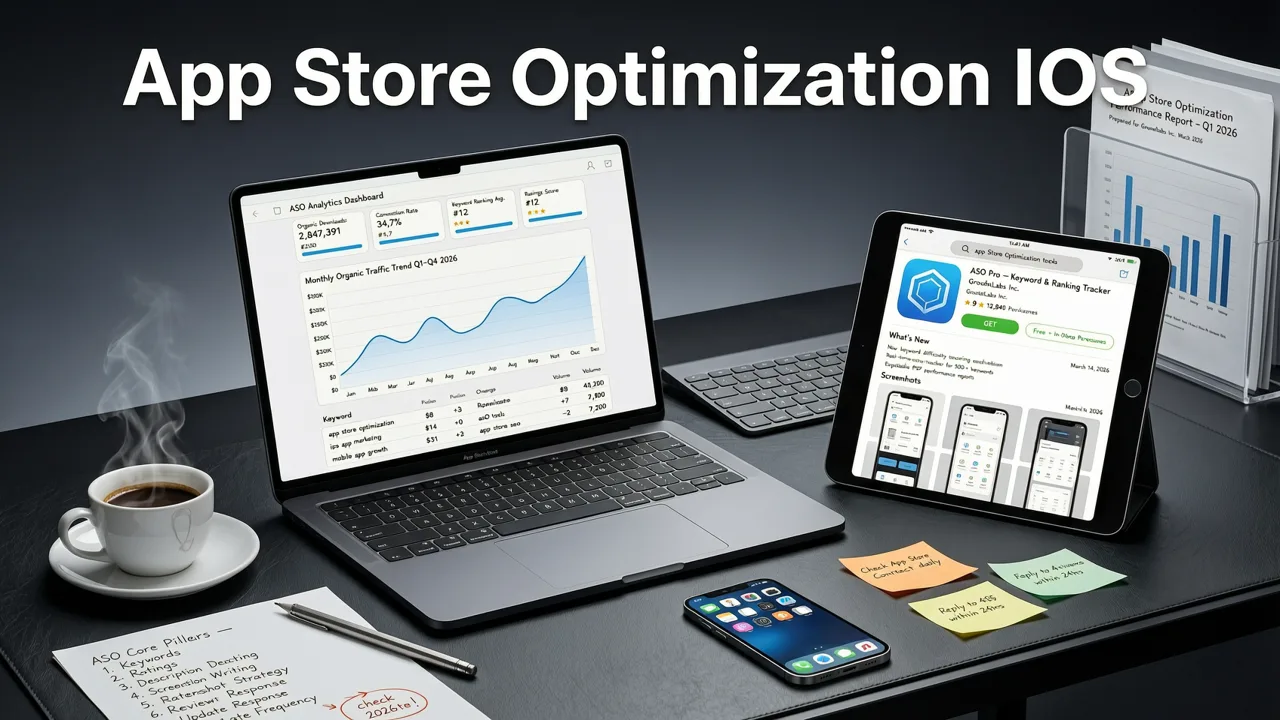
App Store Optimization is not a single tactic. It is a continuous discipline that sits at the intersection of search marketing, conversion rate optimization, and product strategy. A mature ASO engagement for an iOS app typically spans four pillars:
- Keyword intelligence — discovering, prioritizing, and mapping high-value search terms to your metadata fields.
- Creative optimization — testing screenshots, app previews, and icons to maximize tap-through and conversion rates.
- Conversion rate optimization — refining descriptions, subtitles, and promotional text to turn impressions into installs.
- Reputation & retention signals — managing ratings, reviews, and in-app engagement metrics that influence ranking.
Apple's search algorithm in 2026 weighs these factors differently than Google Play, and the nuances matter. Understanding those differences is the foundation of any effective iOS ASO strategy.
How Apple's App Store Algorithm Works in 2026
Apple has never published a complete breakdown of its ranking factors, but years of testing, data analysis, and platform updates have given the ASO community a reliable picture. The algorithm evaluates two core dimensions: relevance and performance.
Relevance Signals
Relevance tells Apple whether your app matches what a user is searching for. The primary metadata fields Apple considers, in approximate order of weight, are:
- App name (up to 30 characters)
- Subtitle (up to 30 characters)
- Keyword field (up to 100 characters, hidden from users)
- In-App Purchase names (indexed since iOS 15, increasingly influential)
- Category and subcategory selection
A common mistake is stuffing the keyword field with popular terms that have no connection to your app's core functionality. Apple's algorithm penalizes metadata-keyword mismatch over time, and in 2026 its natural-language processing is sophisticated enough to detect low-relevance keyword strategies quickly.
Performance Signals
Performance tells Apple whether users actually want your app once they see it. Key performance signals include:
- Download velocity — the rate of new installs over a rolling window.
- Tap-through rate (TTR) — how often users tap your listing after seeing it in search results.
- Conversion rate — how often users install after viewing your product page.
- Ratings and review volume — both the average star rating and the number of recent reviews.
- Engagement and retention — signals like session frequency and day-30 retention that Apple has increasingly incorporated into ranking.
This is why ASO services for iOS apps must go beyond metadata. If your keywords are perfect but your screenshots fail to convert, you will not rank.
Core ASO Services for iOS Apps: What a Professional Engagement Includes
When you hire a qualified ASO provider for your iOS app, here is the scope of work you should expect.
1. Keyword Research & Metadata Strategy
The foundation of any ASO campaign is a data-driven keyword map. A professional provider will:
- Audit your current keyword portfolio and identify ranking gaps.
- Analyze competitor metadata across your top five to ten rivals.
- Build a prioritized keyword list segmented by difficulty, relevance, and search volume.
- Optimize your app name, subtitle, keyword field, and IAP names for maximum coverage without cannibalization.
- Localize metadata for every target market, because keyword relevance varies dramatically by locale.
2. Creative Asset Testing
Your icon, screenshots, and app preview video are the single biggest lever for improving tap-through and conversion rates. A structured creative testing process includes:
- Developing multiple screenshot variants that emphasize different value propositions.
- Running Apple's native product page optimization tests or third-party A/B frameworks.
- Analyzing which creative sets drive the highest conversion rate per impression.
- Iterating on winning variants every four to six weeks to combat creative fatigue.
3. Ratings & Reviews Management
Your average rating and review velocity directly influence both ranking and conversion. ASO services for iOS apps should include:
- Strategic prompt timing to maximize positive review collection without frustrating users.
- Response workflows for addressing negative reviews publicly and constructively.
- Monitoring review sentiment to surface product issues before they damage your rating.
4. Conversion Rate Optimization
Beyond creatives, your promotional text, description structure, and feature callouts all affect whether a user installs after landing on your page. CRO within ASO involves copy testing, layout experimentation, and localization refinement.
5. Ongoing Monitoring & Reporting
ASO is not a set-and-forget discipline. Apple updates its algorithm, competitors change their strategies, and seasonal trends shift keyword demand. Monthly reporting should cover keyword ranking movement, impression-to-install funnels, creative test results, and a forward-looking optimization roadmap.
ASO for iOS vs. Android: Key Differences That Affect Your Strategy
If you are running a cross-platform app, you cannot apply the same ASO playbook to both stores. Here is a comparison of the most important differences:
| Factor | iOS App Store | Google Play Store |
|---|---|---|
| Keyword field | 100-character hidden field | No dedicated keyword field; description is indexed |
| Description indexing | Not indexed for search | Fully indexed for search |
| Title character limit | 30 characters | 30 characters |
| Subtitle / short description | 30-character subtitle (indexed) | 80-character short description (indexed) |
| Screenshot testing | Native product page optimization | Native store listing experiments |
| Algorithm emphasis | Metadata relevance + download velocity | Metadata + engagement + retention signals |
| Localization approach | Per-locale metadata customization | Per-locale metadata with description indexing |
These differences mean that iOS ASO demands a tighter, more surgical approach to metadata, while Android ASO gives you more runway in the description. A competent agency will tailor its strategy to each platform rather than duplicating effort.
How Much Do ASO Services for iOS Apps Cost in 2026?
Pricing varies based on scope, market coverage, and the maturity of your app. Here is a realistic range for 2026:
| Service Tier | Scope | Typical Monthly Investment |
|---|---|---|
| Starter | Single locale, basic keyword optimization, quarterly creative refresh | $1,500 – $3,000 |
| Growth | 3–5 locales, monthly keyword iteration, continuous creative testing, ratings management | $3,000 – $7,000 |
| Enterprise | Global localization, dedicated strategist, advanced CRO, cross-platform coordination | $7,000 – $15,000+ |
Be cautious of providers offering ASO at rock-bottom prices. Sustainable App Store growth requires ongoing analysis, testing, and adaptation. A one-time optimization sprint will give you a short-term bump, but the compounding benefits of ASO come from continuous improvement.
Common ASO Mistakes That Hurt iOS App Rankings
Even experienced product teams make these errors. Avoiding them will put you ahead of most competitors.
Ignoring Localization
Translating your metadata word-for-word is not localization. Keyword relevance, search behavior, and cultural expectations differ by market. A term that drives installs in the US may be irrelevant in Germany or Japan. Professional ASO services for iOS apps include locale-specific keyword research, not just translation.
Neglecting the Keyword Field
The 100-character hidden keyword field is the single most underutilized asset in iOS ASO. Every character counts. Avoid spaces after commas, do not repeat words already in your app name or subtitle, and never waste characters on terms Apple already associates with your app through its category.
Skipping Creative Testing
Many teams design screenshots once at launch and never revisit them. In 2026, creative fatigue is real. Users who have seen your listing multiple times will not convert on the same assets. Plan for a creative refresh cycle every four to six weeks.
Chasing High-Volume Keywords Without Considering Difficulty
Ranking for a broad term like "fitness" is nearly impossible for a new app. A smarter strategy targets mid-tail and long-tail keywords where you can realistically achieve top-10 positions, then expands outward as your download velocity grows.
Treating ASO as Separate From Product
Your app's retention, session frequency, and crash rate all feed into ranking signals. ASO services for iOS apps deliver the most impact when they are integrated with your product and engineering teams. If you are evaluating development partners, our guide on how to choose a mobile app developer covers what to look for in a team that understands this connection.
How ASO Integrates With Your Broader Growth Strategy
ASO does not exist in isolation. The most successful apps treat it as one channel within a coordinated growth engine that includes paid acquisition, content marketing, and product-led growth.
ASO and Paid User Acquisition
Apple Search Ads and your organic ASO strategy should reinforce each other. Paid campaigns can accelerate download velocity for targeted keywords, which in your organic ranking improves over time. Conversely, strong organic rankings reduce your blended cost per install by capturing demand that paid channels would otherwise need to serve.
ASO and Your Website
Your app's web presence supports ASO through deep linking, referral traffic, and brand search volume. If your app has a companion website, its speed and user experience directly affect how users discover and trust your product. Teams evaluating web infrastructure often compare platforms, as explored in our analysis of Shopify vs custom ecommerce websites, and the same principle applies to app landing pages: choose the framework that serves your users fastest.
ASO and UI/UX
Your in-app experience determines whether the installs you earn through ASO stick. High early churn undermines your retention signals and, over time, your rankings. Investing in a mobile app UI/UX audit before scaling your ASO spend ensures that your conversion funnel inside the app is as strong as your store listing.
How to Choose the Right ASO Partner for Your iOS App
Not all ASO providers deliver the same results. When evaluating partners, prioritize the following:
- Platform specialization. iOS and Android ASO require different playbooks. Choose a partner that demonstrates deep iOS expertise, not just generic mobile ASO.
- Data transparency. You should have full access to ranking data, creative test results, and conversion metrics. Black-box reporting is a red flag.
- Testing discipline. Ask how many creative tests they run per quarter and what their methodology is for keyword iteration.
- Integration with development. The best ASO outcomes happen when your optimization partner coordinates with your engineering and product teams.
- Case studies with measurable outcomes. Request specific examples of ranking improvements, download growth, and conversion rate lifts they have delivered for apps in your category.
What to Expect From an ASO Engagement: A Realistic Timeline
ASO is a compounding strategy, not an overnight fix. Here is a realistic timeline for what you can expect:
| Timeframe | Expected Outcomes |
|---|---|
| Weeks 1–2 | Full audit, keyword research, metadata optimization deployed |
| Weeks 3–6 | Initial ranking movement on targeted keywords, first creative tests launched |
| Months 2–3 | Measurable improvement in impression-to-install conversion, expanded keyword coverage |
| Months 4–6 | Compounding organic download growth, stronger position on competitive keywords |
| Months 6–12 | Sustainable organic channel contributing 30–50% of total installs for mature apps |
Apps in highly competitive categories may take longer to see top-10 positions on high-value terms. The key is consistent iteration and patience.
The Future of iOS ASO: What's Changing in 2026 and Beyond
Several trends are reshaping how ASO services for iOS apps are delivered:
- AI-driven search behavior. Users are increasingly using natural-language queries and voice search, which favors apps with semantically rich metadata over those relying on exact-match keyword stuffing.
- Privacy-centric attribution. With continued limitations on tracking, on-device signals and first-party engagement data carry more weight in Apple's ranking logic.
- Creative diversity. Short-form video previews and interactive product pages are becoming standard, raising the bar for creative quality.
- Cross-platform coordination. Apps launching simultaneously on iOS, Android, and the web need unified optimization strategies that respect each platform's unique algorithm.
Staying ahead of these shifts requires a partner that invests in ongoing research and adapts its methodology as the platform evolves.
Frequently Asked Questions
How long does it take to see results from ASO services for iOS apps?
Most apps begin seeing measurable ranking movement within three to six weeks of metadata optimization. Significant organic download growth typically compounds over three to six months of continuous testing and iteration.
Is ASO still effective in 2026 given the rise of AI search?
Yes. While AI-powered discovery surfaces are growing, the App Store search remains the primary channel for iOS app discovery. ASO has evolved to address natural-language queries and semantic relevance, making it more effective than ever when executed with modern methodology.
Should I manage ASO in-house or hire an agency?
In-house ASO works if you have a dedicated specialist with access to enterprise-grade tools and time for continuous testing. For most startups and SMEs, a specialized agency delivers faster results because of cross-category experience, established testing frameworks, and dedicated focus.
What is the most important factor in iOS App Store ranking?
There is no single factor, but keyword relevance in your app name, subtitle, and keyword field combined with download velocity and conversion rate are the strongest drivers. Ratings and engagement signals play a supporting but meaningful role.
Can ASO help if my app already has paid user acquisition?
Absolutely. ASO and paid acquisition are complementary. Strong organic rankings lower your blended cost per install, improve your Apple Search Ads performance through relevance signals, and create a sustainable download base that is not dependent on ad spend.
Start Growing Your iOS App's Organic Presence Today
App Store Optimization is not a luxury for mature apps. It is a foundational growth channel that every iOS app should invest in from day one. The right ASO services for iOS apps will give you a structured, data-driven approach to ranking higher, converting better, and building a sustainable organic download engine.
If you are ready to evaluate your current App Store presence and identify the highest-impact opportunities, the team at Devsrank can help. We combine ASO strategy with full-stack mobile development, UI/UX design, and growth marketing to help startups and businesses ship faster and scale sustainably. Reach out to start a conversation about your iOS app's growth roadmap.
Frequently Asked Questions
How long does it take to see results from ASO services for iOS apps?
Is ASO still effective in 2026 given the rise of AI search?
Should I manage ASO in-house or hire an agency?
What is the most important factor in iOS App Store ranking?
Can ASO help if my app already has paid user acquisition?
Related topics
Need expert help?
Turn these insights into a better digital product.
Share your goals with our team and get a practical plan for design, development, performance, or growth.
Start a conversation