Building a medical application is vastly different from engineering a standard consumer product. The healthcare mobile app development process demands a rigorous balance of clinical utility, strict regulatory compliance, and seamless user experience. In 2026, this process encompasses everything from initial HIPAA and GDPR compliance mapping to complex EHR integration and post-launch App Store Optimization (ASO).
This guide outlines the exact phases required to engineer a secure, scalable, and user-centric healthcare application, ensuring your product meets both clinical standards and market demands.
Why the Healthcare Mobile App Development Process Requires Specialized Strategy
Healthcare applications operate in a highly regulated environment where a single data breach or clinical workflow error can have severe consequences. Unlike standard e-commerce or media apps, medical software must prioritize data security, interoperability, and accessibility above all else.
In 2026, the baseline expectations for health-tech products have evolved. Patients expect the same frictionless digital experience from their telemedicine platforms as they get from their banking apps. Meanwhile, healthcare providers require intuitive interfaces that reduce cognitive load and integrate seamlessly with existing hospital systems.
Navigating these dual expectations requires a structured approach. For non-technical healthcare entrepreneurs, understanding this strategic landscape is the first step toward a successful launch. You can explore foundational strategies in our Software Development for Non Technical Founders: 2026 Guide to align your clinical vision with technical execution.
The 7-Step Healthcare Mobile App Development Process
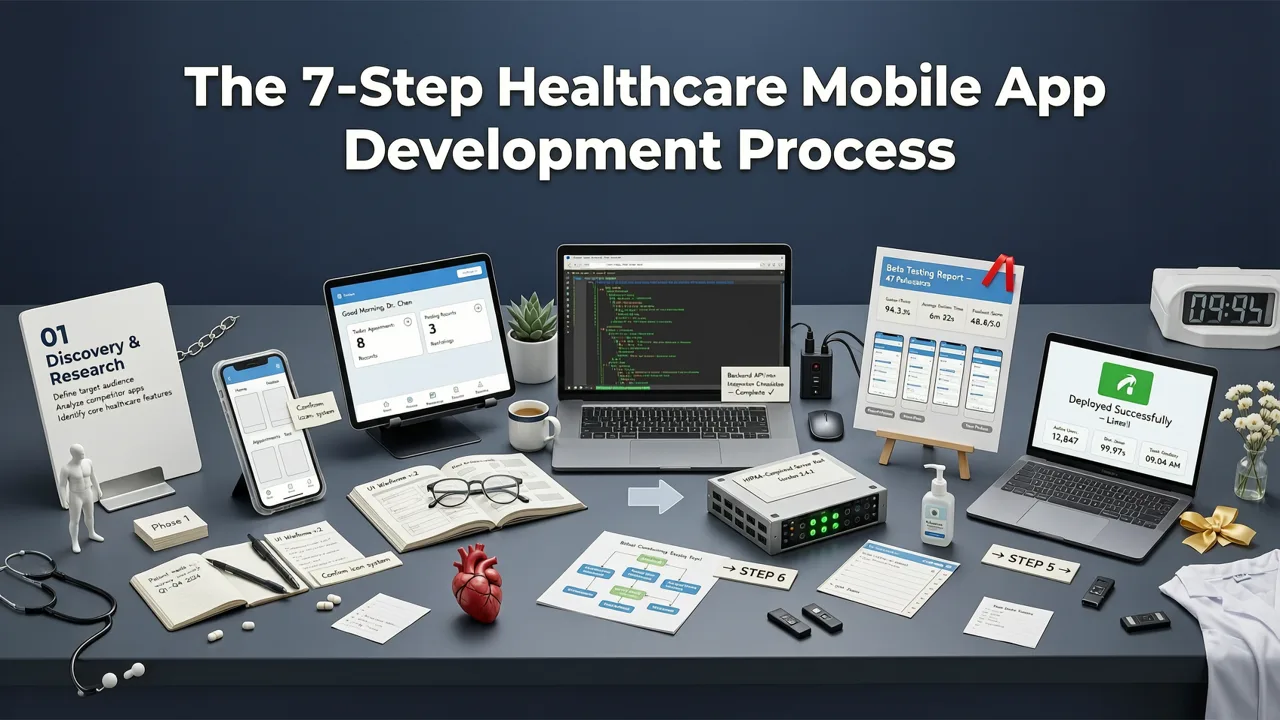
A successful medical app is never built by accident. It is the result of a meticulous, phased approach that mitigates risk while maximizing clinical value. Here is the comprehensive framework used to build healthcare applications in 2026.
1. Discovery and Regulatory Compliance Planning
The foundation of any health-tech project is a deep understanding of the regulatory landscape. Depending on your target markets, your app must comply with HIPAA (US), GDPR (Europe), or PIPEDA (Canada). During the discovery phase, engineering and product teams map out data flow diagrams to identify where Protected Health Information (PHI) is created, stored, and transmitted. This phase also defines the core clinical problem the app solves, ensuring the product vision aligns with actual patient or provider needs.
2. Clinical Workflow Mapping and Feature Definition
Before writing a single line of code, the team must map the clinical workflow. How does a patient book an appointment? How does a physician review remote monitoring data? Defining these workflows prevents feature bloat and ensures the application supports, rather than disrupts, daily medical operations. Core features often include secure messaging, appointment scheduling, prescription management, and remote patient monitoring (RPM) dashboards.
3. UI/UX Design for Patients and Providers
Healthcare apps often serve two distinct user bases: patients and providers. Each requires a tailored interface. Patient-facing screens must be highly accessible, adhering to WCAG guidelines, with large typography and simple navigation. Provider-facing screens must prioritize data density and rapid task completion.
Evaluating your interface early is crucial. Many agencies recommend securing a comprehensive review before engineering begins. You can Get a Free Mobile App UI UX Audit in 2026 to ensure your clinical workflows translate into intuitive digital experiences.
4. Secure Architecture and Tech Stack Selection
Selecting the right technology stack is critical for security and scalability. In 2026, interoperability is non-negotiable. Your architecture must support modern data exchange standards like HL7 FHIR (Fast Healthcare Interoperability Resources) to communicate with existing Electronic Health Records (EHR) systems.
Teams must also decide between native and Top Cross Platform Software Development Frameworks 2026. While native development offers maximum performance for complex hardware integrations (like Bluetooth medical devices), modern cross-platform frameworks now deliver near-native performance with a unified codebase. Explore dedicated Cross-Platform App Development Services to balance budget constraints with enterprise-grade security.
5. Agile Development and EHR Integration
Development proceeds in agile sprints, focusing on building secure, modular components. A major focus during this phase is API integration. Connecting your app to legacy EHR systems like Epic or Cerner requires robust middleware and strict adherence to FHIR R5 standards. Security protocols, including end-to-end encryption, multi-factor authentication (MFA), and automated session timeouts, are baked directly into the codebase rather than added as an afterthought.
6. Rigorous QA, Security Audits, and Penetration Testing
Quality Assurance in healthcare goes far beyond checking for broken buttons. The QA process must include:
- Functional Testing: Verifying all clinical workflows operate flawlessly.
- Interoperability Testing: Ensuring seamless data exchange with third-party health systems.
- Security Audits: Conducting third-party penetration testing to identify vulnerabilities.
- Compliance Validation: Documenting all security measures for HIPAA or GDPR certification.
7. Launch, ASO, and Continuous Compliance Monitoring
Deploying a healthcare app to the Apple App Store or Google Play Store requires navigating strict medical app guidelines. Both platforms require clear documentation of how health data is handled. Post-launch, the focus shifts to App Store Optimization (ASO) and continuous monitoring. Healthcare apps require ongoing updates to maintain compliance with evolving privacy laws and to patch newly discovered security vulnerabilities.
Core Healthcare App Modules and Technical Requirements
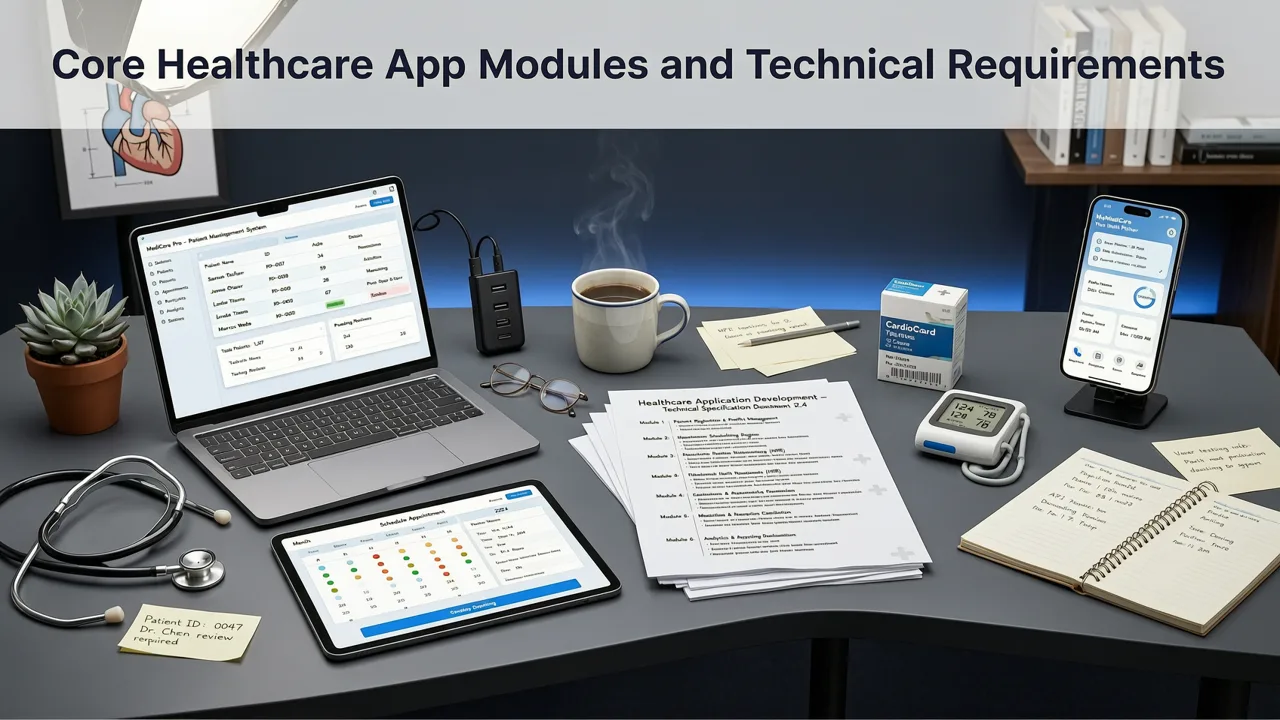
Understanding the specific technical requirements for different healthcare modules helps in accurate resource planning and risk assessment. The table below outlines common features and their corresponding technical and compliance demands.
| App Module | Core Functionality | Key Technical Requirement | Compliance Focus |
|---|---|---|---|
| Patient Portal | Access medical records, lab results, and visit summaries | Role-Based Access Control (RBAC) and AES-256 encryption | HIPAA Privacy Rule, GDPR Article 9 |
| Telemedicine | Secure video consultations and in-app messaging | WebRTC for low-latency video, TLS 1.3 for data in transit | HIPAA Security Rule, BAA agreements |
| Remote Monitoring | Ingest data from wearable devices and Bluetooth sensors | IoT API integration, edge computing for real-time alerts | FDA Software as a Medical Device (SaMD) guidelines |
| EHR Integration | Sync patient data with hospital systems (Epic, Cerner) | HL7 FHIR R5 API middleware, OAuth 2.0 for smart auth | ONC Health IT Certification, HIPAA |
Common Pitfalls to Avoid in Healthcare App Engineering
Even with a solid plan, healthcare projects can stumble if teams overlook critical nuances. Avoid these common mistakes to ensure a successful launch.
Ignoring Offline Capabilities
Healthcare providers often work in areas with poor connectivity, such as basement radiology departments or rural clinics. Failing to build offline-first capabilities means the app becomes useless when the network drops. Implementing local data caching with secure, encrypted sync protocols is essential for clinical continuity.
Treating Compliance as an Afterthought
Attempting to bolt on HIPAA compliance after the app is built is a recipe for disaster. It usually requires tearing down the architecture and rebuilding it securely. Compliance must be integrated into the discovery and architecture phases from day one.
Neglecting Post-Launch ASO
Many health-tech startups spend millions on development but zero on discoverability. If patients and providers cannot find your app in the store, it will fail. A robust ASO strategy, including keyword optimization for medical terms and localized store listings, is critical for user acquisition.
Conclusion
The healthcare mobile app development process is a complex journey that requires deep expertise in clinical workflows, stringent security protocols, and modern interoperability standards. By following a structured, compliance-first approach, startups and established healthcare providers can build applications that genuinely improve patient outcomes and streamline provider efficiency. Whether you are refining your initial concept or preparing for a major platform launch, ensuring your user experience and technical architecture are aligned is critical. Review your current product strategy and consider leveraging expert resources to guide your development journey toward a secure, scalable, and compliant 2026 release.
Frequently Asked Questions
What is the most critical phase of the healthcare mobile app development process?
How long does it take to build a compliant healthcare app?
What is the difference between native and cross-platform for medical apps?
How do you ensure HIPAA compliance during development?
Related topics
Need expert help?
Turn these insights into a better digital product.
Share your goals with our team and get a practical plan for design, development, performance, or growth.
Start a conversation