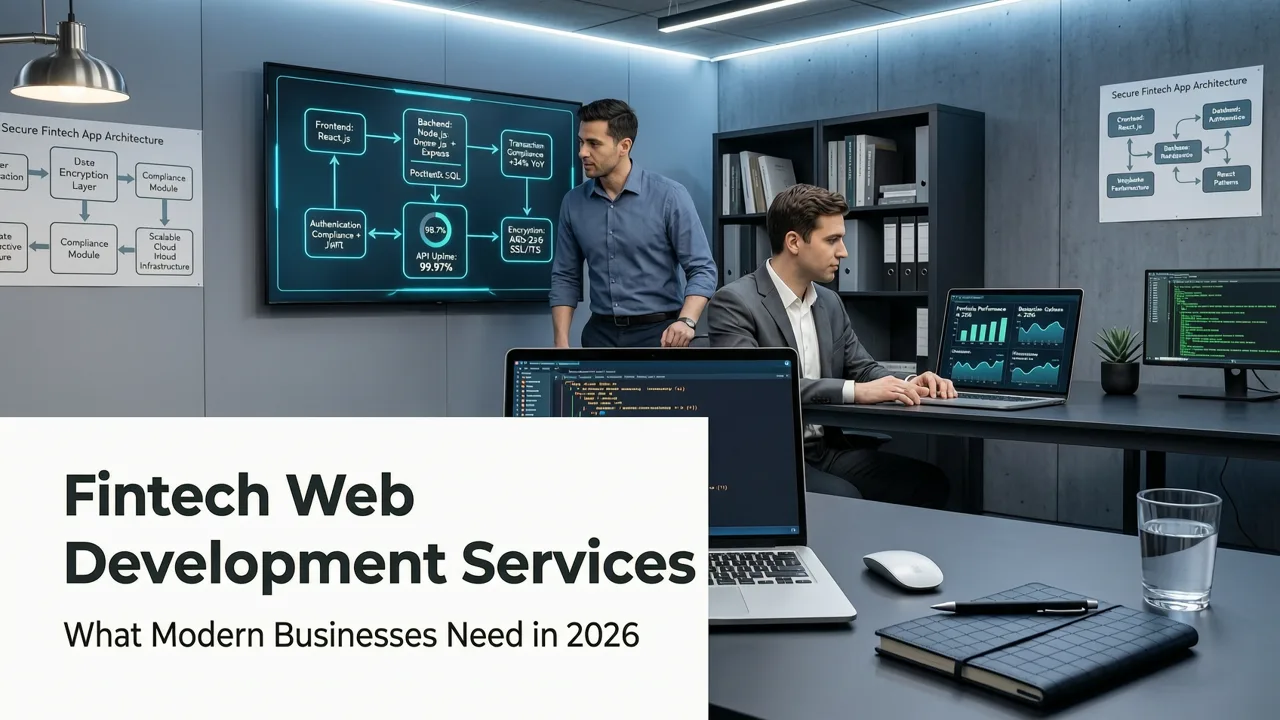
Fintech Web Development Services: What Modern Businesses Need in 2026
In 2026, financial technology is no longer just about moving money; it is about delivering frictionless, hyper-personalized, and strictly compliant digital experiences. If you are launching a financial product, relying on generic builders is a massive liability. This guide explores how specialized fintech web development services bridge the gap between complex regulatory requirements and seamless user experiences, ensuring your platform is built to scale securely from day one.
The modern financial consumer expects instant transactions, biometric authentication, and real-time portfolio insights. Meeting these expectations requires a fundamental shift in how web applications are architected. It demands a move away from monolithic structures toward event-driven, microservices-based ecosystems that can handle massive transaction spikes without compromising data integrity.
Why Standard Web Builds Fail Fintech Startups
Many founders initially attempt to launch their financial products using standard content management systems or off-the-shelf templates. While these tools are excellent for marketing sites or basic retail, they fundamentally lack the infrastructure required for financial data. Standard builds typically fail fintech startups in three critical areas:
- Regulatory Compliance: Off-the-shelf platforms are not pre-configured for the rigorous audit trails, data localization laws, and encryption standards mandated by financial regulators.
- Granular Security: Standard builds often rely on perimeter security. Fintech applications require zero-trust architectures, where every API call and user session is continuously verified.
- Complex API Orchestration: Integrating with legacy banking cores, open banking APIs, and third-party fraud detection engines requires custom middleware that generic platforms simply cannot support.
For early-stage companies, recognizing these limitations early is crucial. Partnering with experts who understand Website Development Services for Startups in 2026 ensures that your technical foundation is aligned with both your immediate launch goals and your long-term regulatory obligations.
Core Pillars of Fintech Web Development Services
Delivering a secure, scalable financial web application requires a disciplined, multi-phase approach. Here is what comprehensive fintech web development actually looks like in practice.
1. Strategic Discovery and Compliance Mapping
Before a single line of code is written, a thorough discovery phase must map the regulatory landscape of your target markets. This involves identifying whether your product falls under PSD3 in Europe, specific state-level money transmitter laws in the US, or regional data sovereignty rules in Asia. Strategic discovery translates these legal requirements into technical specifications, ensuring that compliance is baked into the architecture rather than bolted on as an afterthought.
2. Security-First Architecture
Security in fintech web development goes far beyond SSL certificates. It requires implementing end-to-end encryption for data at rest and in transit, integrating FIDO2 standards for passwordless biometric authentication, and establishing automated vulnerability scanning in the CI/CD pipeline. A robust architecture also includes strict role-based access control (RBAC) and comprehensive logging to ensure that every action within the application is auditable.
3. Scalable API and Microservices Integration
Modern fintech platforms rely heavily on external data and services. Whether you are pulling credit scores, verifying identities via KYC providers, or routing payments through multiple gateways, your web application must handle these integrations seamlessly. Utilizing a microservices architecture ensures that if one third-party service experiences downtime, the rest of your application remains fully operational, preserving the user experience and system reliability.
Comparing Fintech Web Development to Standard Platforms
Understanding the distinction between general web development and specialized financial engineering is vital for budget allocation and project planning. The table below outlines the core differences in approach and execution.
| Feature | Standard Web Development | Fintech Web Development Services |
|---|---|---|
| Primary Focus | Visual appeal, content delivery, basic user conversion | Transaction security, regulatory compliance, data integrity |
| Architecture | Monolithic or simple CMS structures | Event-driven microservices and API gateways |
| Security Model | Perimeter defense, standard authentication | Zero-trust architecture, biometric auth, end-to-end encryption |
| Third-Party Integrations | Marketing tools, basic analytics, simple payment gateways | Open banking APIs, KYC/AML providers, legacy banking cores |
| Audit and Logging | Basic error logging and user tracking | Immutable audit trails for every transaction and data access |
When your product involves complex transaction flows, digital wallets, or merchant portals, the line between financial tech and retail begins to blur. In these cases, leveraging specialized Ecommerce Website Development Services that understand high-stakes transactional security becomes just as important as the core banking features.
How to Choose the Right Fintech Web Development Partner
Selecting an agency to build your financial platform is one of the most critical decisions your business will make. You need a partner that combines deep technical expertise with a strong understanding of product strategy and user experience.
When evaluating potential partners, look for proven experience in highly regulated sectors such as fintech, healthcare, or enterprise logistics. Ask detailed questions about their approach to security, their familiarity with the specific compliance frameworks relevant to your business, and their methodology for handling complex API integrations.
It is also important to balance budget with value. While fintech development requires a higher initial investment than a standard marketing site, choosing a partner that offers Affordable Custom Website Development Services ensures you maximize long-term value without compromising on the security and scalability your financial product demands.
Launch Your Financial Product with Confidence
Building a fintech web application in 2026 requires more than just coding skills; it demands a strategic partner who understands the intersection of user experience, regulatory compliance, and high-performance engineering. By prioritizing security-first architecture and scalable microservices, you can create a platform that not only meets today's rigorous standards but is also prepared for the financial innovations of tomorrow.
If you are ready to build a secure, compliant, and scalable financial web platform, Devsrank combines product strategy, UI/UX design, and elite engineering to help you ship faster and grow sustainably. Contact our team today to discuss your product vision and discover how our specialized development services can bring your fintech solution to market with confidence.
Frequently Asked Questions
What makes fintech web development services different from standard web development?
Which compliance standards must a fintech web platform meet in 2026?
How long does it take to build a custom fintech web application?
Can fintech web development services integrate with legacy banking systems?
Related topics
Need expert help?
Turn these insights into a better digital product.
Share your goals with our team and get a practical plan for design, development, performance, or growth.
Start a conversation